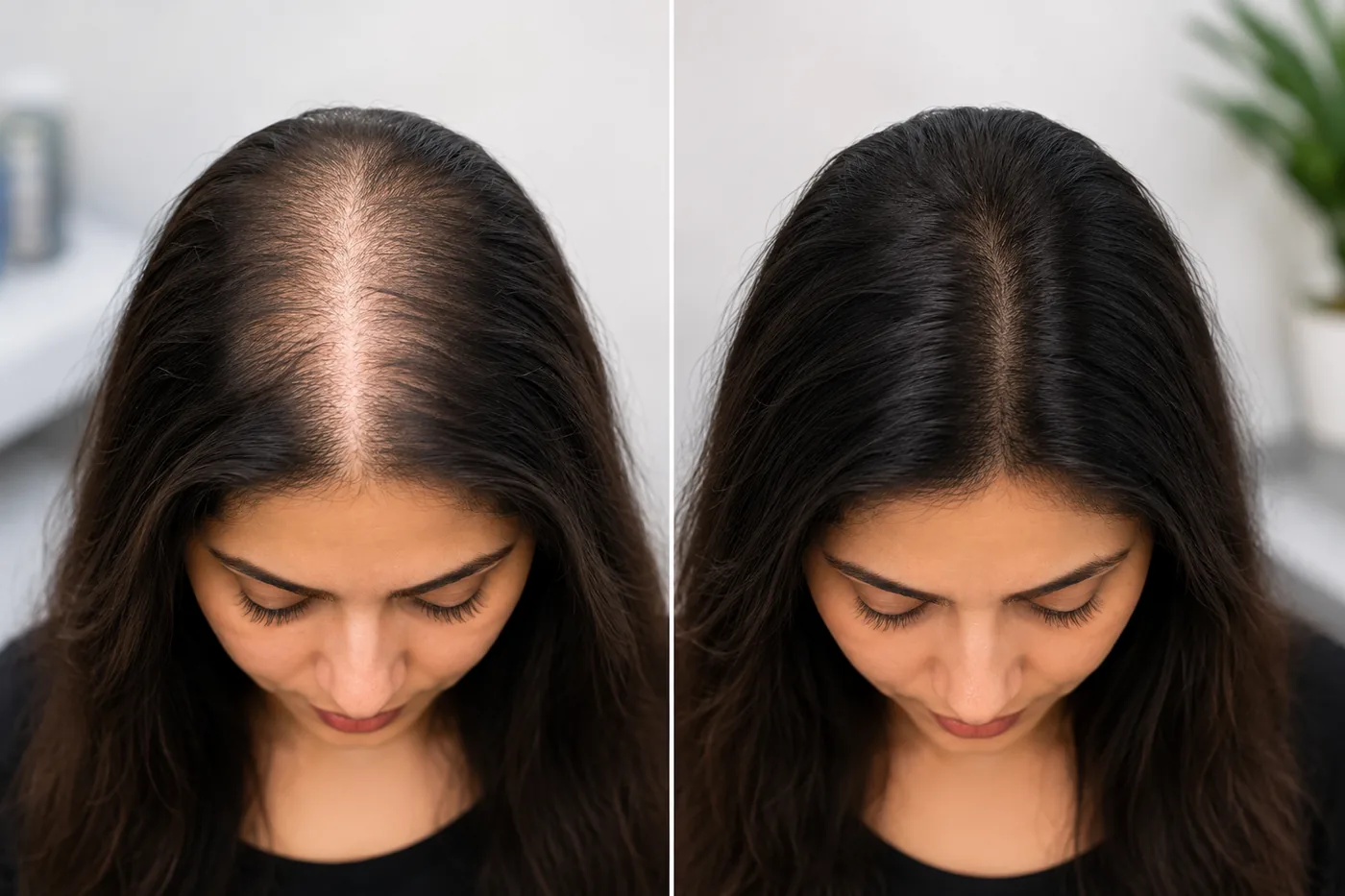
How does a hair transplant work for women?
The principle is the same as in men. Hair at the back and sides of the scalp is usually less affected by pattern hair loss, so follicles moved from there tend to keep growing in their new location. The surgeon harvests them either as a strip of skin (FUT) or one at a time (FUE), divides them into grafts of one to four hairs, and places them into tiny incisions in the thinning area.
The procedure is done as a same-day outpatient treatment under local anaesthetic and usually takes 4–8 hours. Women's procedures often differ in the details: they're more commonly done without shaving, the grafts are placed between existing hairs rather than into bare skin, and the hairline design is softer and rounder than a typical male hairline.
Who is a good candidate for a female hair transplant?
Careful surgeons are selective, and the checklist below reflects what most look for. You're more likely to be a candidate if:
- Your hair loss has a confirmed diagnosis and a clear, localised pattern
- The donor area is dense and shows little miniaturisation under magnification
- Your thinning has been stable for a year or more, often with medical treatment
- Any underlying causes, such as low iron or thyroid problems, have been treated
- You have realistic expectations about density - a transplant redistributes hair, it doesn't create more
- You're in good general health and not pregnant or breastfeeding
Which types of female hair loss respond well to a transplant?
Suitability depends heavily on the cause. This table summarises how surgeons usually view the most common situations:
| Type of hair loss | Transplant suitability | Why |
|---|---|---|
| Traction alopecia | Often good | Localised loss with a healthy donor area, once the tension has stopped |
| High or uneven natural hairline | Often good | Donor hair is usually unaffected |
| Scars from surgery, injury or burns | Often good | Stable area; blood supply to the scar needs assessing |
| Female pattern hair loss, localised | Sometimes | Works if thinning is concentrated on top and the donor area is strong |
| Diffuse thinning, including the donor area | Usually not | Donor hair may thin too, so grafts may not last |
| Telogen effluvium (shedding) | No | Usually temporary; hair often regrows on its own |
| Active alopecia areata or scarring alopecia | Usually not | The condition can attack new grafts; needs medical control first |
Why aren't more women good candidates?
The main issue is the donor area. In most men with pattern baldness, the back and sides stay thick for life. Many women with female pattern hair loss have thinning that spreads more evenly across the scalp - sometimes called diffuse unpatterned alopecia - and that includes the zone a surgeon would harvest from. Follicles taken from a weak donor area may not survive long term.
Women also tend to have more native hair left in the recipient area. That's a good thing cosmetically, but it raises the risk of shock loss, where existing hairs shed temporarily after surgery. Most of that hair grows back, but already-miniaturised hairs may not. This is why a good surgeon will sometimes say no, and why that answer is worth taking seriously.
What tests should you have before deciding?
A hair transplant should never be the first step for an undiagnosed woman. Before surgery, expect or ask for:
- A dermatology assessment to identify the type of hair loss and rule out conditions that make surgery unsuitable.
- Blood tests, commonly iron stores, thyroid function and, where relevant, hormone levels.
- Trichoscopy, a magnified scalp exam that shows miniaturisation in both the thinning and donor areas.
- A scalp biopsy if a scarring or inflammatory condition is suspected.
- Standardised photos to document your starting point.
A hair restoration dermatologist can manage this workup and tell you honestly whether surgery makes sense.
What results can a woman realistically expect?
A successful transplant makes a thinning area look noticeably fuller, softens a widened part, or restores a hairline or temple. It won't return the density you had at 18, and results depend on how many grafts your donor area can safely provide.
The timeline is the same as for men: transplanted hairs typically shed in weeks 2–4, regrowth starts around month 3, visible change appears by month 6, and the final result arrives around 12 months. Transplanted follicles are generally long-lasting, but the hair around them can keep thinning, which is why most surgeons recommend continuing treatment such as minoxidil. See are hair transplants permanent for more.
What are the risks for women?
Serious complications are uncommon. The risks worth discussing include temporary shock loss of native hair, swelling around the forehead and eyes for a few days, numbness in the donor or recipient areas, folliculitis (small inflamed bumps), and visible scarring if the donor area is over-harvested. With FUT, there's a linear scar, which is usually easy to hide under longer hair. Our problems hub covers what can go wrong and how it's handled.
What are the alternatives if you're not a candidate?
Plenty of women improve their hair without surgery. Topical minoxidil is FDA-approved for women, and doctors may prescribe off-label options such as spironolactone or low-dose oral minoxidil. PRP and low-level laser devices are other options, with evidence that's promising but mixed. Hair toppers, fibres and good styling can make a big visual difference too. Our female hair restoration guide compares them all.
What's the next step?
Start with a diagnosis, then consult one or two surgeons who treat women regularly and can show you female before-and-after results. Ask them to assess your donor area directly and explain why you are or aren't a candidate. When you're ready, request free quotes from vetted US providers to compare your options.
Related guides
Frequently asked
There's no reliable single figure, but surgeons generally agree only a minority of women with hair loss are good candidates. The deciding factors are a localised pattern, a stable diagnosis and a strong donor area.
They can look very natural when grafts are placed at the right angles among existing hair and hairlines are designed with a soft, irregular edge. Always review the surgeon's results in women, not just men.
Yes, age itself isn't a barrier. What matters is the cause of thinning and your donor density. Some conditions, such as frontal fibrosing alopecia, are more common after menopause and need ruling out first.
Usually not. Many surgeons offer FUT, which needs no visible shaving, or partial-shave and unshaven FUE, where only hidden sections are trimmed. Ask about no-shave FUE at your consultation.
Sometimes. If thinning is concentrated along the part and the donor area is strong, grafts can add density there. If thinning is diffuse across the scalp, medical treatment is usually the better first step.
Surgeons generally postpone elective hair transplants during pregnancy and breastfeeding. Postpartum shedding is also common and often resolves on its own, so it's sensible to wait and reassess.
Most US female procedures cost $4,000–$12,000, depending on graft count, technique and location. See our female hair transplant cost guide for a full budget breakdown, including ongoing treatment.
About this guide
This is an independent overview to help you decide. Figures are typical US ranges, not a quote, and general information is not medical advice - confirm details at a consultation. See our methodology and disclosure.