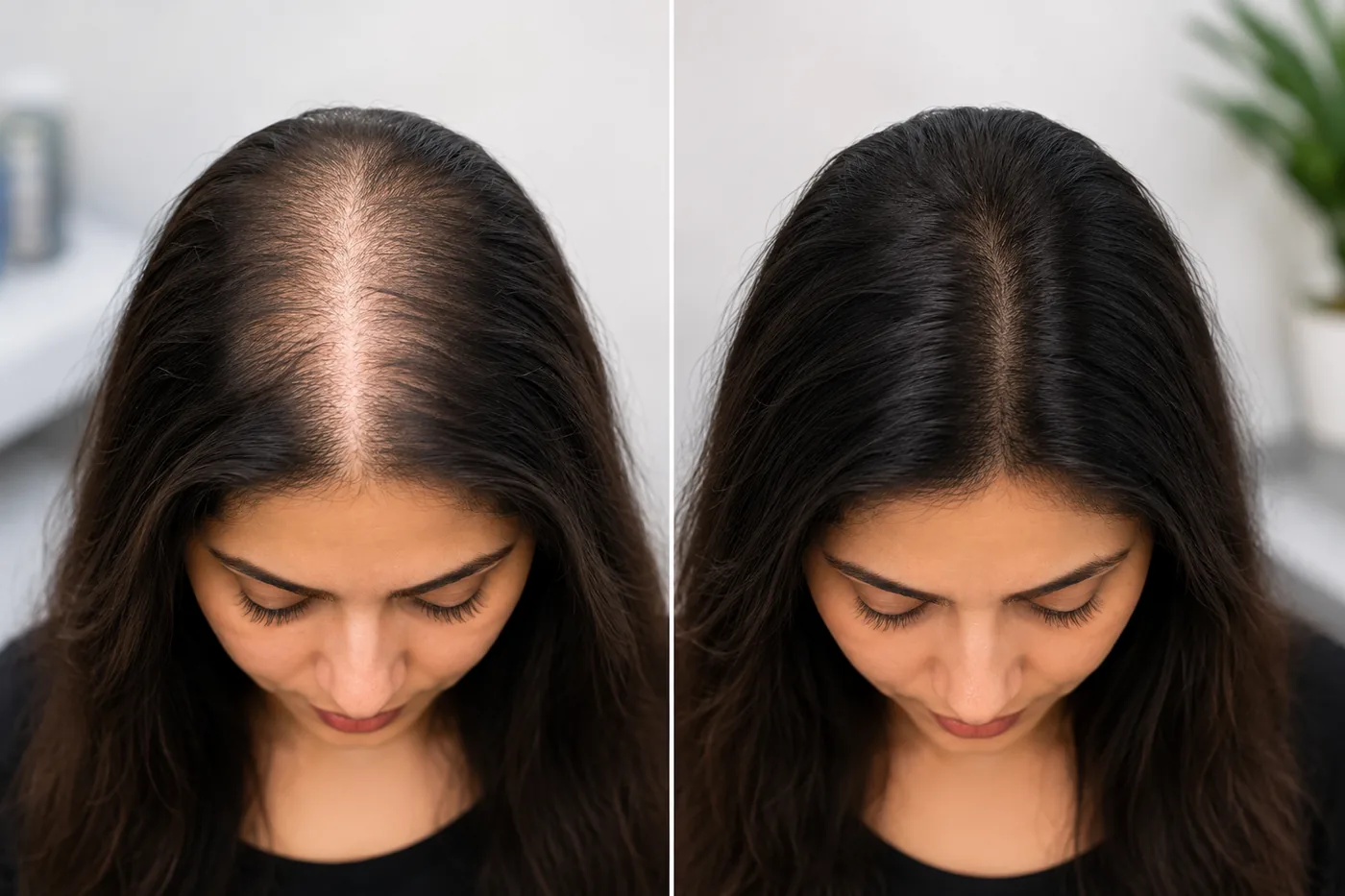
Is FUE a good option for women?
For the right candidate, yes. Follicular unit extraction removes follicles one at a time from the back and sides of the scalp using a small punch, typically under 1 mm wide. There's no strip of skin removed and no stitches, so recovery at the donor site is usually quick and the scarring is a scattering of tiny dots rather than a line.
The question for women is less 'does FUE work?' and more 'is FUE the best way to use my donor hair?' That depends on how dense your donor area is, how many grafts you need, how you wear your hair, and whether your hair loss is the type that responds to a transplant at all. If you're still working out candidacy, start with our female hair transplant guide.
How does FUE compare with FUT for women?
Both techniques give the same kind of growth once grafts take hold. The differences for women are mostly about the donor area, scarring and shaving:
| Factor | FUE | FUT (strip) |
|---|---|---|
| Donor scarring | Tiny dot scars spread over a wider area | One fine linear scar, hidden under longer hair |
| Shaving | Full, partial or unshaven options | No visible shaving; only the strip area is trimmed |
| Graft yield from a thinner donor area | Can be limited, as extraction thins the whole zone | Often efficient, since density outside the strip is preserved |
| Donor recovery | Usually mild soreness for a few days | Tightness and stitches for 10–14 days |
| Short hairstyles at the back | Better suited | Scar may show with very short hair |
| Typical US price | About $5–$8 per graft; unshaven often higher | About $3–$6 per graft |
For the general comparison beyond women's cases, see FUE vs FUT.
How do women avoid shaving with FUE?
Traditional FUE shaves the donor area, which is a deal-breaker for many women. Most US surgeons who treat women now offer alternatives. With partial-shave FUE, a band or small windows are clipped at the back and covered by the longer hair above. With unshaven or long-hair FUE, individual hairs are trimmed just before extraction, leaving the rest untouched. The recipient area is usually left unshaven too, with grafts placed between existing hairs.
These approaches take longer, often cost more, and may limit how many grafts can be moved in one day. Our no-shave FUE guide explains the variations in detail.
Which women tend to suit FUE best?
- Women with a dense, healthy donor area and little miniaturisation at the back and sides
- Those needing a small to moderate number of grafts, such as temple, hairline or scar repairs
- Women who wear their hair short at the back or want the option to in future
- Anyone with a tight scalp that makes strip removal harder
- Women who want to avoid stitches and have a faster donor recovery
- Those treating traction alopecia or a high hairline with an otherwise strong donor supply
When might FUT be the smarter choice?
FUT is sometimes overlooked because FUE gets most of the marketing attention, but it has real advantages for women. Because female hair loss can affect donor density, extracting many individual follicles across the back of the head may leave that area noticeably thinner. FUT concentrates the harvest in one narrow strip and leaves the surrounding hair at full density.
FUT may be the better fit if you need a larger number of grafts, have moderate donor density, wear your hair at shoulder length or longer, and want the lower per-graft price. Some surgeons also combine the two across separate sessions. A surgeon who offers both techniques can give a more balanced recommendation than one who only performs one.
Recovery is another factor to weigh. FUT involves stitches or staples at the back, a feeling of tightness for a week or two, and a return visit to remove them. FUE avoids that, but a large unshaven FUE case can mean a longer day in the chair. Neither difference is usually decisive; donor quality and the number of grafts you need matter more.
How much does FUE cost for women?
US FUE typically costs $5–$8 per graft. Women's FUE procedures often fall between 800 and 2,500 grafts, which usually puts the total somewhere between about $4,000 and $12,000, with unshaven techniques toward the top or above. Large metros often sit toward the upper end, and clinic minimum fees can raise the price of very small cases. Insurance almost never covers it, and financing over 24–48 months is common. See cost of a hair transplant for women for a full breakdown.
What should you ask an FUE surgeon before booking?
- Is my donor area dense enough for FUE, or would FUT preserve it better?
- How many grafts can you safely take from my donor area over my lifetime?
- Which shaving option do you recommend for me, and how does it affect cost and graft numbers?
- What punch size do you use, and who performs the extractions?
- How many female FUE patients have you treated, and can I see their results at 12 months?
- How do you reduce the risk of shock loss in existing hair?
- What medical treatment do you recommend alongside surgery?
Look for board-certified surgeons, and treat ISHRS membership as a helpful signal. Be cautious if a clinic offers only one technique and dismisses the other without examining you.
How do you compare FUE clinics?
Ask two or three surgeons to assess your donor area in person or from detailed photos, and compare their technique recommendations, graft estimates and itemised prices. A consistent recommendation across surgeons is reassuring; big differences are worth questioning. Our provider selection guide covers vetting, and you can request free quotes from vetted US providers to start comparing.
Related guides
Frequently asked
It depends on your donor area and hairstyle. FUE avoids a linear scar and suits short hair or smaller cases. FUT often yields more grafts from a moderate donor area and hides well under long hair.
FUE leaves tiny dot scars that are usually invisible under hair of normal length. Over-harvesting can cause visible thinning in the donor area, which is why extraction limits matter.
Donor dots typically heal within about a week, and recipient scabs usually clear in 7–10 days. Transplanted hair grows back from around month 3, with final results at about 12 months.
Only if the donor area is still reasonably dense. If thinning affects the back and sides as well, FUE may not be suitable, and medical treatment is usually recommended first.
DHI is a variation of FUE that uses a pen-like implanter to place grafts. Harvesting is the same. Some clinics favour it for placing grafts among existing hair. Compare them in DHI vs FUE.
It can add density along a part when thinning is concentrated there and the donor area is strong. For diffuse thinning, surgeons usually recommend medical treatment rather than FUE.
Sapphire FUE uses sapphire blades to make recipient incisions. Some clinics say it heals faster, but good results depend far more on surgeon skill and candidacy. See sapphire FUE.
About this guide
This is an independent overview to help you decide. Figures are typical US ranges, not a quote, and general information is not medical advice - confirm details at a consultation. See our methodology and disclosure.