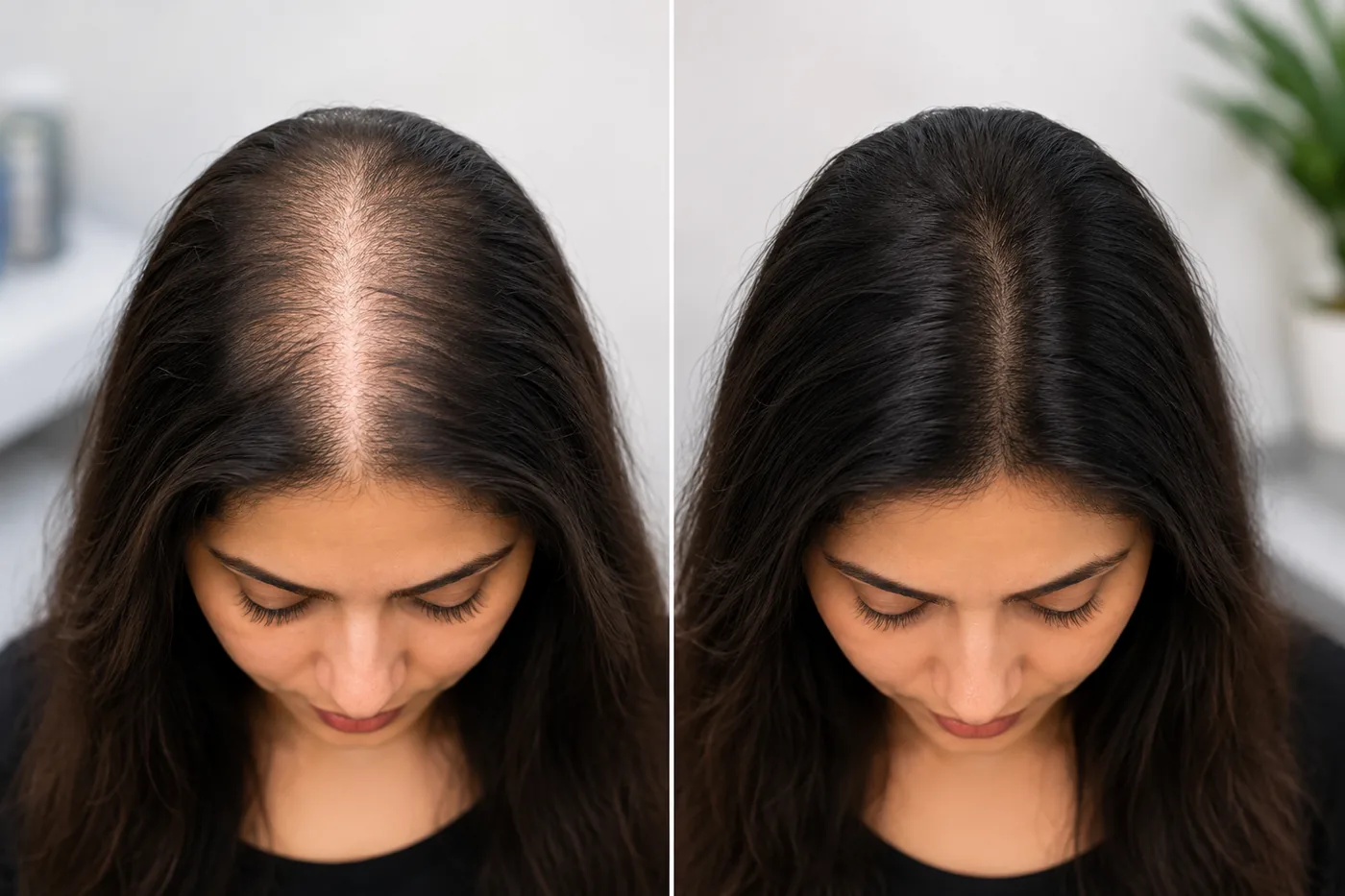
What happens at an FUE consultation for a woman?
The consultation decides whether FUE will work for you, so a thorough one takes time. A surgeon experienced with female patients will usually:
- Take a detailed history covering when thinning started, family history, pregnancies, menopause, medications and styling habits
- Review or request blood tests if the cause hasn't been confirmed
- Examine the recipient area and the donor area under magnification to check for miniaturised hairs
- Estimate donor density and how many grafts could be safely removed
- Discuss your goals and design the area - for example, softening a hairline, rebuilding temples or thickening a part
- Explain shaving options, likely graft numbers, costs and the risk of shock loss
- Recommend any medical treatment to use before and after surgery
Bring photos from a few years ago if you have them. They help show how quickly your hair has changed.
How is FUE performed, step by step?
- Marking and photos. The surgeon draws the treatment area and photographs it.
- Donor preparation. Hairs in the extraction zone are trimmed - in a hidden band, small windows, or one by one for unshaven FUE.
- Numbing. Local anaesthetic is injected into the donor area.
- Extraction. Using a punch usually under 1 mm wide, follicular units are scored and gently removed, spread out to avoid visible thinning.
- Graft care. Technicians sort grafts by hair count and keep them in a chilled storage solution.
- Recipient sites. After numbing the front or top, the surgeon makes tiny incisions between existing hairs, matching their angle and direction.
- Placement. Grafts go in one by one, with single-hair grafts at the hairline edge and multi-hair grafts behind for density.
- Final check and bandaging. The donor area may be lightly dressed; the recipient area is usually left open.
How many grafts do women typically need by area?
Graft needs depend on the size of the area, your hair's thickness and colour contrast, and your donor supply. These are rough ranges surgeons often work within:
| Treatment area | Typical graft range | Notes |
|---|---|---|
| Temple points or small hairline refinement | 300–800 | Mostly single-hair grafts; clinic minimum fees often apply |
| Traction alopecia at temples and hairline | 800–1,500 | Tension must have stopped; scarred skin may need a second pass |
| Thinning along the part | 800–1,500 | Grafts placed among native hair; shock-loss risk discussed |
| Hairline lowering with grafts | 1,500–2,500+ | Depends on how far the line moves; may need two sessions |
| Scar from facelift or injury | 200–1,000 | Scar tissue may be tested with a small session first |
At typical US FUE prices of $5–$8 per graft, most of these fall within about $4,000–$12,000. Read how many grafts do I need for more on estimating.
What are the first two weeks like?
The first night is usually the most uncomfortable, with soreness and tightness as the anaesthetic wears off. Swelling can drift to the forehead and around the eyes on days 2–4, especially after hairline work. Sleeping with your head raised helps. Donor extraction points form tiny scabs and generally heal within a week, and they're covered by longer hair if you had an unshaven procedure.
In the recipient area, small crusts form around each graft and usually fall away with gentle washing by days 7–10. Avoid scratching, tight ponytails, clips and hats over the grafts, and follow your clinic's washing routine exactly. Most women return to desk work within about a week. For step-by-step care, see FUE hair transplant aftercare.
When will you see results?
FUE results arrive slowly, and the middle months can test your patience:
- Weeks 2–4: transplanted hairs shed, which is expected. Some native hair nearby may shed too.
- Months 1–3: the area looks much as it did before surgery while follicles rest.
- Months 3–4: fine new hairs start to break through.
- Month 6: visible change, although hairs are still thickening.
- Month 12: close to the final result; texture continues to improve for some women.
See hair transplant results for what influences the outcome.
What can go wrong, and how is it avoided?
Complications are uncommon with a well-selected patient and an experienced team. The main issues to understand are:
- Shock loss of native hair - reduced by careful site placement and, often, medical treatment around surgery
- Donor over-harvesting, leaving the back looking thin - avoided by conservative extraction limits
- Low graft survival from damaged or dried-out grafts - reduced by skilled extraction and good graft handling
- Unnatural angles or a harsh hairline - avoided by experience with female hairline design
- Folliculitis or small cysts as hairs grow through - usually minor and treatable
- Infection - rare, and most often managed quickly when reported early
How do you know the result will look natural?
Natural results in women come from a few details: a soft, slightly irregular hairline rather than a straight edge, single-hair grafts at the front, grafts angled to follow your existing hair flow, and density that blends with the surrounding hair rather than looking packed. When you review a surgeon's portfolio, look for women with a similar hair type, colour and pattern of loss to yours, photographed with hair pulled back and in consistent lighting at 12 months or later.
Ask, too, how the surgeon plans for the future. Female hair loss can progress around a transplant, so a good design leaves room for change: it doesn't use up the donor supply in one session, and it places grafts where they'll still look right if surrounding hair thins further. Continuing treatment such as minoxidil helps keep the transplanted and native hair blending together.
Ready to explore FUE?
If your hair loss is diagnosed, localised and stable, an FUE consultation is a sensible next step. Compare how different surgeons assess your donor area and what they recommend - including whether they'd suggest FUT instead. Read about the hair transplant process, or request free quotes from vetted US FUE surgeons.
Related guides
Frequently asked
Usually not. Many surgeons offer unshaven or partial-shave FUE, where only small hidden areas or individual hairs are trimmed. Longer hair above covers the donor area while it heals.
Yes, but curved follicles under the skin make extraction more technically demanding. Choose a surgeon with specific experience and results in textured hair, which is also common in traction alopecia repair.
Some clinics offer PRP during or right after FUE. Evidence that it improves graft growth is promising but mixed, so treat it as optional and ask what it adds to the cost.
Age alone doesn't rule out FUE. Surgeons look at general health, donor density and the cause of thinning. Conditions more common after menopause, such as frontal fibrosing alopecia, should be excluded first.
Many women need only one. A second session may be recommended for extra density, hairline lowering or scarred areas, typically at least 12 months after the first.
Many patients fly within a day or two after checking with their surgeon. Protect the grafts from bumps, avoid tight headwear, and make sure you can follow your aftercare routine while travelling.
About this guide
This is an independent overview to help you decide. Figures are typical US ranges, not a quote, and general information is not medical advice - confirm details at a consultation. See our methodology and disclosure.