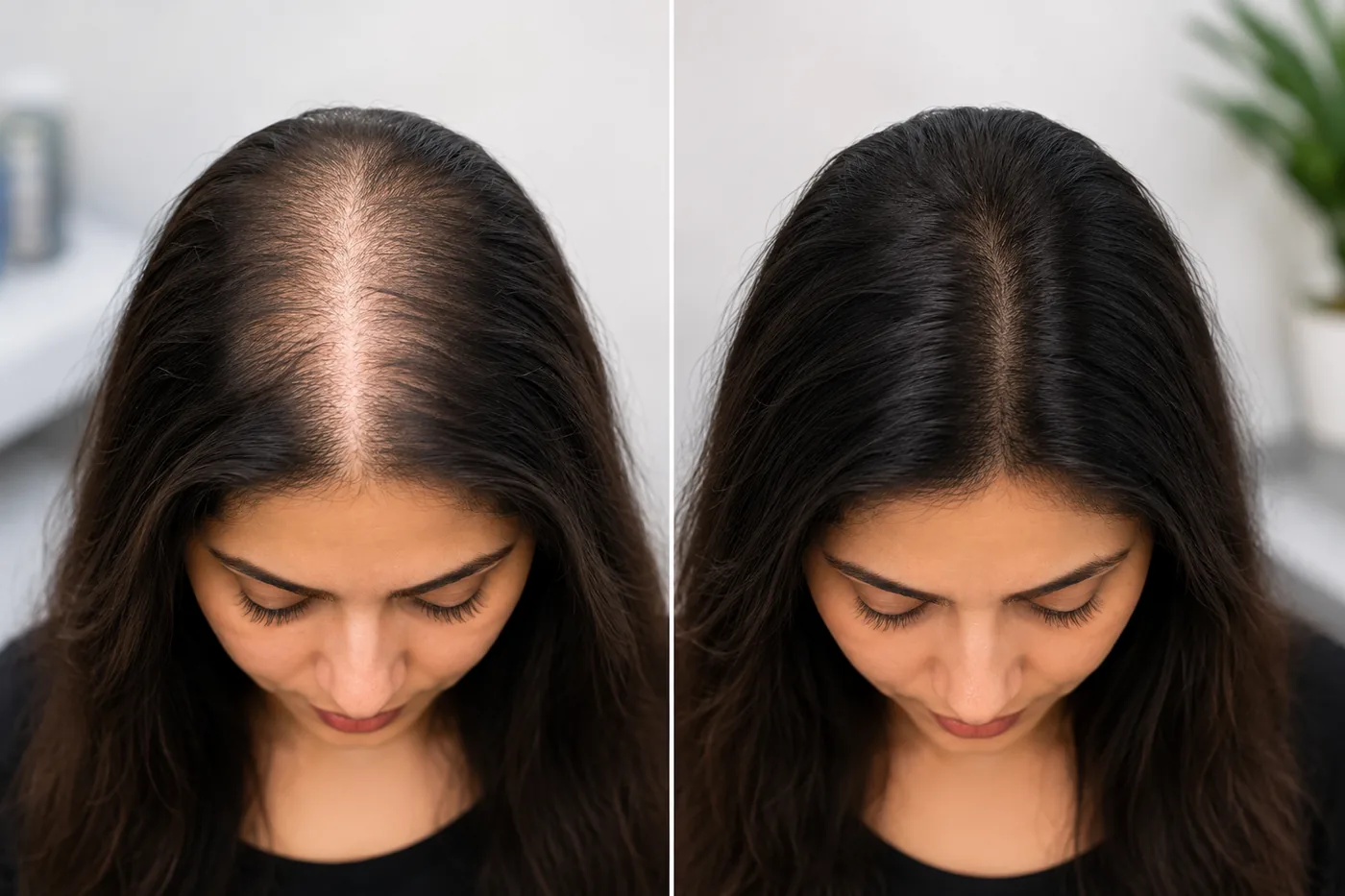
Where should a woman start with hair restoration?
The first step isn't a shampoo, a supplement or a clinic package - it's working out what's happening. Thinning that started suddenly after an illness needs a different response from a part that's been widening slowly for five years. A dermatologist visit and a few blood tests often answer that question in one or two appointments.
Before that appointment, gather useful information: when you first noticed the change, any recent life events (childbirth, surgery, weight loss, new medication, stopping contraception), family history, and how you usually style your hair. Take a few clear photos of your part and hairline now, in daylight and with your hair dry. They'll be your baseline for everything that follows. For a detailed look at causes, read hair restoration for women.
What does a step-by-step restoration plan look like?
Most successful plans follow a similar order. Skipping steps is one of the most common reasons women spend money without seeing results.
- Get a diagnosis. A dermatologist identifies the type of hair loss and checks for treatable causes like low iron or thyroid problems.
- Fix what's fixable. Treat deficiencies, change damaging styling habits, and review medications with your doctor.
- Start first-line treatment. For pattern thinning, that's usually minoxidil, sometimes with a prescription medication.
- Give it time. Commit to 6–12 months of consistent use before judging whether it works.
- Reassess with photos. Compare against your baseline in the same lighting and angles.
- Add or adjust. Consider PRP, a laser device, or a change of medication if progress is limited.
- Consider surgery last. If loss is localised and stable, a transplant consultation makes sense.
How long before you know a treatment is working?
Hair grows slowly, so patience is part of the plan. This is a rough guide for medical treatment such as minoxidil:
| Timeframe | What you might notice | What to do |
|---|---|---|
| Weeks 2–8 | Possible increase in shedding as follicles reset | Keep going; this is common and usually temporary |
| Months 3–4 | Shedding settles; little visible change yet | Take comparison photos |
| Months 6–9 | Less scalp showing, finer new hairs along the part | Review progress with your doctor |
| Month 12 | Clearer picture of your response | Decide whether to continue, add treatments, or consider surgery |
If you're shedding from a temporary trigger, regrowth follows a similar slow timeline once the trigger has passed.
How do you track progress accurately?
Mirrors are unreliable because you see your hair every day and lighting changes constantly. A simple tracking routine makes decisions much easier:
- Photograph your part, crown and hairline every 3 months in the same spot, lighting and camera distance
- Keep the hair dry, unstyled and parted in the same place
- Note your treatments, doses and any missed weeks in a phone note
- Measure your ponytail's thickness with a tape measure if you wear one
- Record major life events, illness or stress that could affect shedding
Share these photos with your doctor at review appointments. Side-by-side comparisons taken months apart often reveal improvement that's impossible to see day to day - and they're just as useful for spotting a treatment that isn't working, so you can change course sooner. If you later consult a surgeon, a record showing that your hair loss has been stable for a year is exactly what they'll want to see.
Which options fit different situations?
A woman's starting point often depends on her stage of life and the type of change she's noticed. These are common starting points, not a substitute for medical advice:
| Situation | Common cause to rule out or confirm | Sensible first move |
|---|---|---|
| Heavy shedding a few months after childbirth | Postpartum telogen effluvium, low iron | Blood tests; wait and reassess if results are normal |
| Slowly widening part in your 20s–40s | Female pattern hair loss, PCOS | Dermatologist visit; minoxidil |
| Thinning around perimenopause or menopause | Pattern thinning, thyroid changes, frontal fibrosing alopecia | Full workup; discuss medical options |
| Bare temples after years of tight styles | Traction alopecia | Stop tension; transplant consultation if no regrowth |
| Naturally high forehead | No disease - a genetic hairline | Surgical consultation for grafts or hairline lowering |
| Sudden round bald patches | Alopecia areata | Prompt dermatology appointment |
How much should you budget at each stage?
Costs rise as you move along the plan, so the order also protects your wallet. Diagnosis often costs a few hundred dollars and may be partly covered by insurance. Topical minoxidil is a modest monthly expense. PRP typically costs $500–$1,500 per session in the US, with 3–4 initial sessions. A transplant for women usually costs $4,000–$12,000, rarely covered by insurance, with financing over 24–48 months widely available. See our women's hair transplant cost guide for detail.
What mistakes slow women's progress?
- Stopping minoxidil during the early shed, just before it would have started working
- Taking high-dose biotin without a deficiency - it rarely helps and can distort some blood test results
- Switching products every few weeks, which makes it impossible to tell what works
- Continuing tight styles or heavy extensions while trying to regrow the same area
- Booking surgery before a diagnosis, especially for diffuse thinning
- Paying for unproven treatments such as stem cell or exosome packages, which are experimental and not FDA-approved for hair loss
When is it time to talk to a surgeon?
Consider a surgical consultation if your hair loss is localised - at the temples, hairline, part or a scar - and has been stable for about a year, or if medical treatment has stopped the thinning but left an area you'd like to fill. Choose a surgeon who treats women regularly and will examine your donor area closely. When you're ready, request free quotes from vetted US providers, or browse the treatment process hub to see what's involved.
Related guides
Frequently asked
Only a proper assessment can tell you. Shedding after a trigger usually recovers, while pattern thinning and scarring conditions are long-term. Shiny, smooth skin where hair used to grow can suggest follicles have been lost permanently.
A dermatologist is a medical doctor who can diagnose conditions, order tests and prescribe treatment. Trichologists can offer useful hair and scalp advice but can't prescribe, so start with a dermatologist if you're unsure of the cause.
Many women do. A common approach is to pause minoxidil for a day before and after colouring to reduce scalp irritation. Check with your doctor or stylist if your scalp is sensitive.
Softer layers, a side part that moves regularly, and adding volume at the roots can all help. Avoid tight, slicked-back styles that expose the scalp and add tension to thinning areas.
It's rarely too late to protect the hair you still have. Treatment works best on follicles that are thinning rather than gone, so earlier is better, but many women benefit after years of gradual loss.
Yes. A lightweight topper can give coverage while medical treatment takes effect. Rotate clip placement and remove it at night to avoid adding traction to thinning areas.
About this guide
This is an independent overview to help you decide. Figures are typical US ranges, not a quote, and general information is not medical advice - confirm details at a consultation. See our methodology and disclosure.