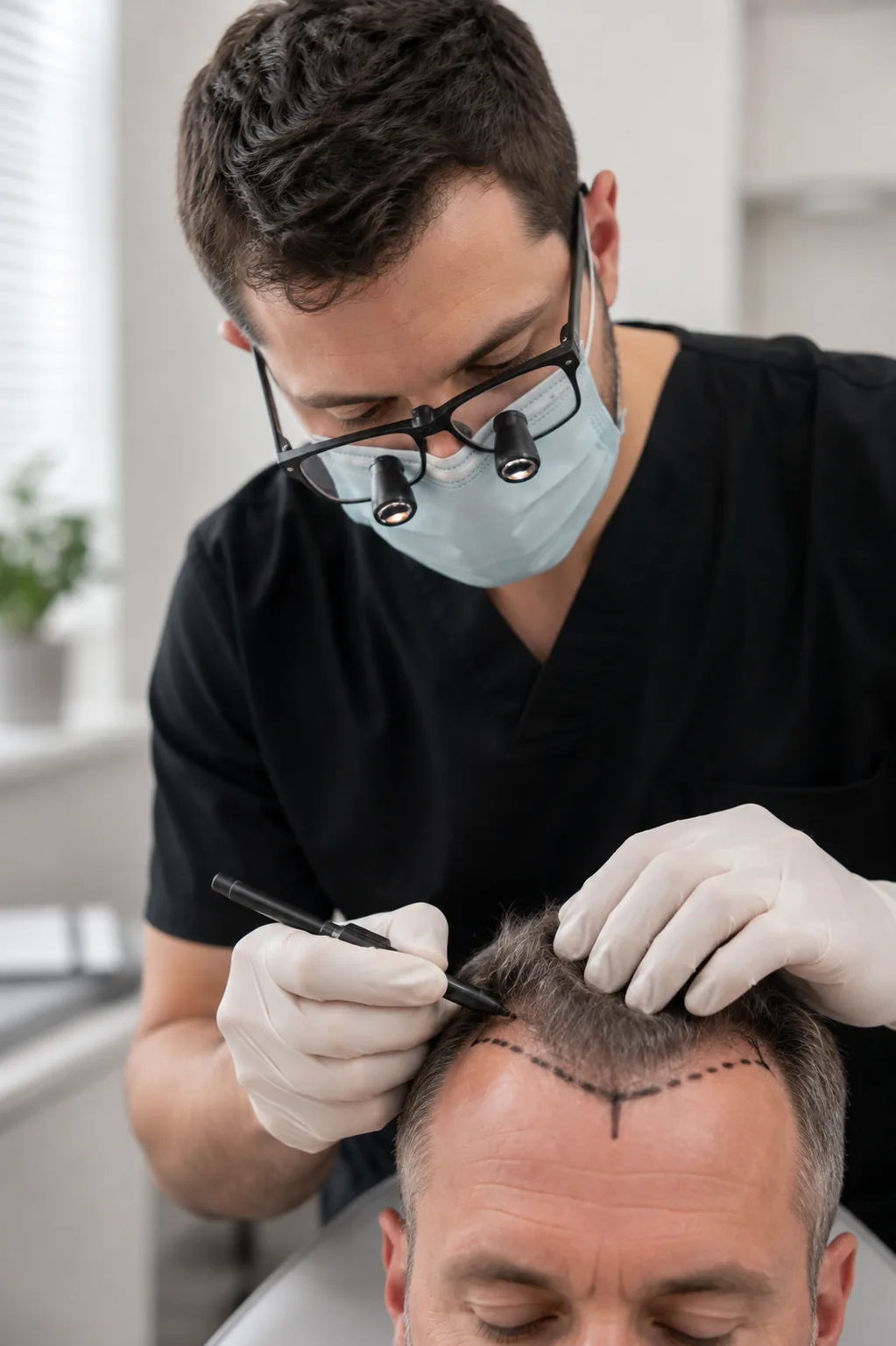
What's the difference between FUE and FUT?
The difference is how the donor hair is harvested. FUE removes follicular units one at a time with a small punch, leaving scattered dot scars. FUT removes a thin strip of scalp and stitches it closed, leaving a single linear scar. Everything after harvesting - preparing and implanting grafts - is essentially the same.
What is FUE, and what are its pros and cons?
FUE is the most popular method today because it avoids a linear scar and heals faster. The trade-off is a higher per-graft cost and longer procedure time for large cases.
FUE pros
- No linear scar - good for short hair
- Faster recovery
- Less post-op discomfort
FUE cons
- Higher cost per graft
- Longer for very large sessions
- Requires shaving the donor area
What is FUT, and what are its pros and cons?
FUT (the strip method) can yield the most grafts in a single session and usually costs less per graft - useful for advanced hair loss. The downside is a linear donor scar and a slightly longer recovery.
FUT pros
- Most grafts per session
- Lower cost per graft
- Donor area isn't fully shaved
FUT cons
- One linear scar
- Slower recovery
- Not ideal for very short styles
What is DHI?
DHI (direct hair implantation) is a variation of FUE. Instead of creating recipient sites first, the surgeon implants each graft directly with a pen-like tool, allowing precise control over angle and density. It's essentially FUE with a different implantation step, and often costs a little more.
What is Sapphire FUE?
Sapphire FUE is FUE that uses sapphire-tipped blades to create the recipient sites. The finer incisions can support dense, natural-looking placement and quicker healing. It's popular in Turkey - see whether the premium is worth it in DIY vs professional.
Which method gives the best results in the US?
There's no universal "best." The right technique depends on your hair-loss stage, donor supply, budget, and hairstyle. An experienced surgeon will recommend FUE, FUT, or DHI based on your case - which is why choosing the right clinic matters more than the method name.
Related guides
Common questions
FUT is usually cheaper per graft because it's less labour-intensive. For large cases that can mean a lower total, but FUE avoids a linear scar, which many patients prefer.
FUE leaves tiny dot scars that are hard to see even with short hair. FUT leaves one linear scar along the donor strip, usually hidden by surrounding hair.
There's no single best method - it depends on your hair-loss pattern, donor area, budget, and how you wear your hair. A good surgeon recommends the technique that suits your case.
Sources & notes
Comparisons reflect typical technique characteristics; individual results and pricing vary by surgeon and case. Confirm specifics at consultation.
- International Society of Hair Restoration Surgery (ISHRS) - technique overviews.
- American Academy of Dermatology (AAD) - hair transplant methods.
- Peer-reviewed comparisons of FUE, FUT, and DHI.
