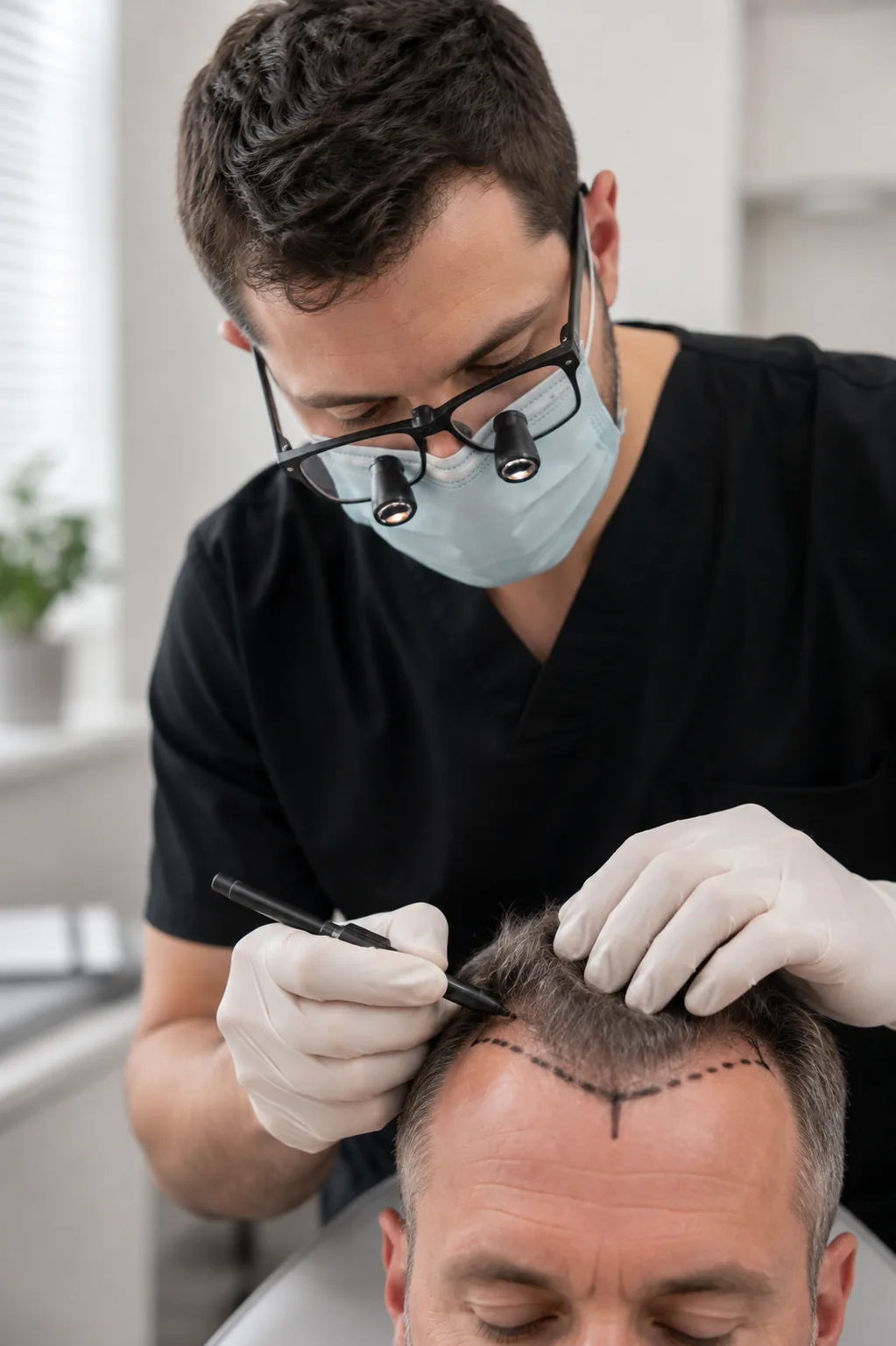
What is the real difference between DHI and FUE?
Every hair transplant has three stages: harvesting grafts, making recipient sites, and placing grafts. DHI (Direct Hair Implantation) and FUE (Follicular Unit Extraction) share the first stage exactly - follicles are extracted individually from the donor area with a small punch.
The difference comes afterwards. In standard FUE, the surgeon creates all the recipient incisions in advance with a fine blade or needle, then the team places grafts into them with forceps. In DHI, each graft is loaded into a hollow needle device, often called a Choi implanter pen, which punctures the skin and deposits the graft in a single step.
So when people ask "DHI vs FUE", they're really comparing two ways of implanting FUE grafts. If you're new to the basics, start with what FUE is.
How do DHI and FUE compare side by side?
| Factor | DHI (implanter pen) | Standard FUE (sites then forceps) |
|---|---|---|
| Harvesting | Individual punch extraction | Individual punch extraction |
| Site creation | Made at the moment of implantation | All sites made first, in a planned pattern |
| Angle and depth control | Set per graft by the pen operator | Set when sites are made, usually by the surgeon |
| Placing between existing hair | Often easier without full shaving | Possible, but usually easier on shaved scalp |
| Grafts per session | Often lower - slower and more staff-intensive | Often higher for large sessions |
| Typical cost | Often priced at a premium | Around $5–$8 per graft in the US |
| Best suited to | Hairline refinement, densifying thinning areas | Larger bald areas and big graft counts |
Does DHI give better results than FUE?
There's no strong evidence that one implantation method consistently produces better growth than the other. Results depend far more on the skill of the team, how well grafts are handled, and how carefully the hairline and density are planned.
DHI marketing often claims higher graft survival because grafts spend less time out of the body. In practice, grafts are still extracted before loading, and a well-run FUE team also minimises out-of-body time. Treat any clinic promising dramatically better survival from DHI alone with caution.
What does matter is consistency. A pen used by a tired or inexperienced operator can place grafts too deep, too shallow or at the wrong angle, just as forceps placement can go wrong in unskilled hands. When you compare clinics, ask to see 12-month results for the specific method they propose, on patients with similar hair type and loss pattern. Dated photos taken in the same lighting and hair length tell you far more than a technique name. A clinic confident in its work will show you plenty of these without hesitation.
What are the advantages of DHI?
- Placing among existing hair: the pen can slip grafts between native hairs, which helps when densifying thinning areas without shaving the recipient zone
- Angle control per graft: the operator can adjust direction for each implant, useful at the hairline and temples
- Less handling: grafts aren't gripped with forceps at the placement stage, which some surgeons prefer
- Possibly less bleeding at the recipient area, since sites aren't left open while waiting for grafts
What are the downsides of DHI?
- Slower: loading and implanting one graft at a time takes longer, which can limit session size
- More staff and pens needed, which often pushes the price up
- Skill-dependent: the person using the pen effectively decides angle, depth and density - ask who that is
- Less suited to very large areas where 3,000+ grafts need placing efficiently
- Marketing noise: "DHI" is sometimes used as a brand label rather than a clearly different technique
Where does sapphire FUE fit in?
Sapphire FUE is another variation. It uses a sapphire-tipped blade instead of steel to create recipient sites before forceps placement. It changes the incision tool, not the overall method. Clinics sometimes combine terms, such as "sapphire DHI". Our sapphire FUE guide covers what that blade does and doesn't change.
Which is better for your situation?
A rough guide, though your surgeon should confirm:
- Receding hairline or temple refinement, some existing hair: DHI or FUE both work well; DHI may help if you don't want to shave
- Diffuse thinning on top, want to avoid shaving: DHI is commonly used; also consider no-shave FUE
- Large bald crown or Norwood 5–6: standard FUE is usually more efficient, or FUT for maximum grafts
- Tight budget: standard FUE is usually cheaper per graft
- Women with thinning part lines: either, often without full shaving - diagnosis comes first
Graft numbers drive a lot of this choice. Estimate yours with how many grafts do I need.
Is DHI more expensive than FUE?
Often, yes. Because DHI takes more time and staff, clinics frequently charge a premium over their standard FUE rate. In the US, standard FUE usually sits around $5–$8 per graft, and a medium session of 1,500–2,500 grafts typically runs $8,000–$12,000, with DHI commonly quoted higher. Abroad, both are cheaper - Turkish packages often run about $1,500–$3,500 - but quality and physician involvement vary widely. Always compare total price for the same graft count and ask what's included.
How is recovery different between DHI and FUE?
Recovery is very similar because the donor area is harvested the same way. Expect tiny scabs in both donor and recipient areas for 7–10 days, shedding of transplanted hairs in weeks 2–4, new growth from around month 3 and a final result at about 12 months. DHI patients who didn't shave the recipient area may find the procedure easier to hide early on. See the FUE recovery timeline for details.
How do you decide between DHI and FUE?
Ask each clinic why they recommend one method for your case, who will implant the grafts, and what graft count and density they plan. Then compare quotes on the same terms. Request a free quote to hear from vetted US surgeons who offer both.
Related guides
Frequently asked
DHI is a type of FUE. Grafts are harvested the same way; DHI just uses an implanter pen to create the site and place the graft at the same time instead of pre-made incisions and forceps.
Not always. DHI is often chosen for unshaven or partially shaven procedures because grafts can be placed between existing hairs. The donor area may still need trimming, depending on graft count.
Both are done under local anaesthetic and feel very similar. Post-operative discomfort is mostly from the donor area, which is harvested identically. See hair transplant pain.
Like FUE, DHI leaves tiny dot scars in the donor area that are usually hidden by hair a few millimetres long. Very short buzz cuts may reveal them.
DHI can place grafts close together between existing hair, but achievable density depends on the surgeon, scalp blood supply and donor supply rather than the pen itself.
Typically a full day, similar to FUE, and sometimes longer for the same graft count because each graft is loaded and implanted individually.
It can suit women who want to avoid shaving and need grafts placed among existing hair. Many women have diffuse thinning, though, so a medical diagnosis should come before any transplant decision.
About this guide
This is an independent overview to help you decide. Figures are typical US ranges, not a quote, and general information is not medical advice - confirm details at a consultation. See our methodology and disclosure.
