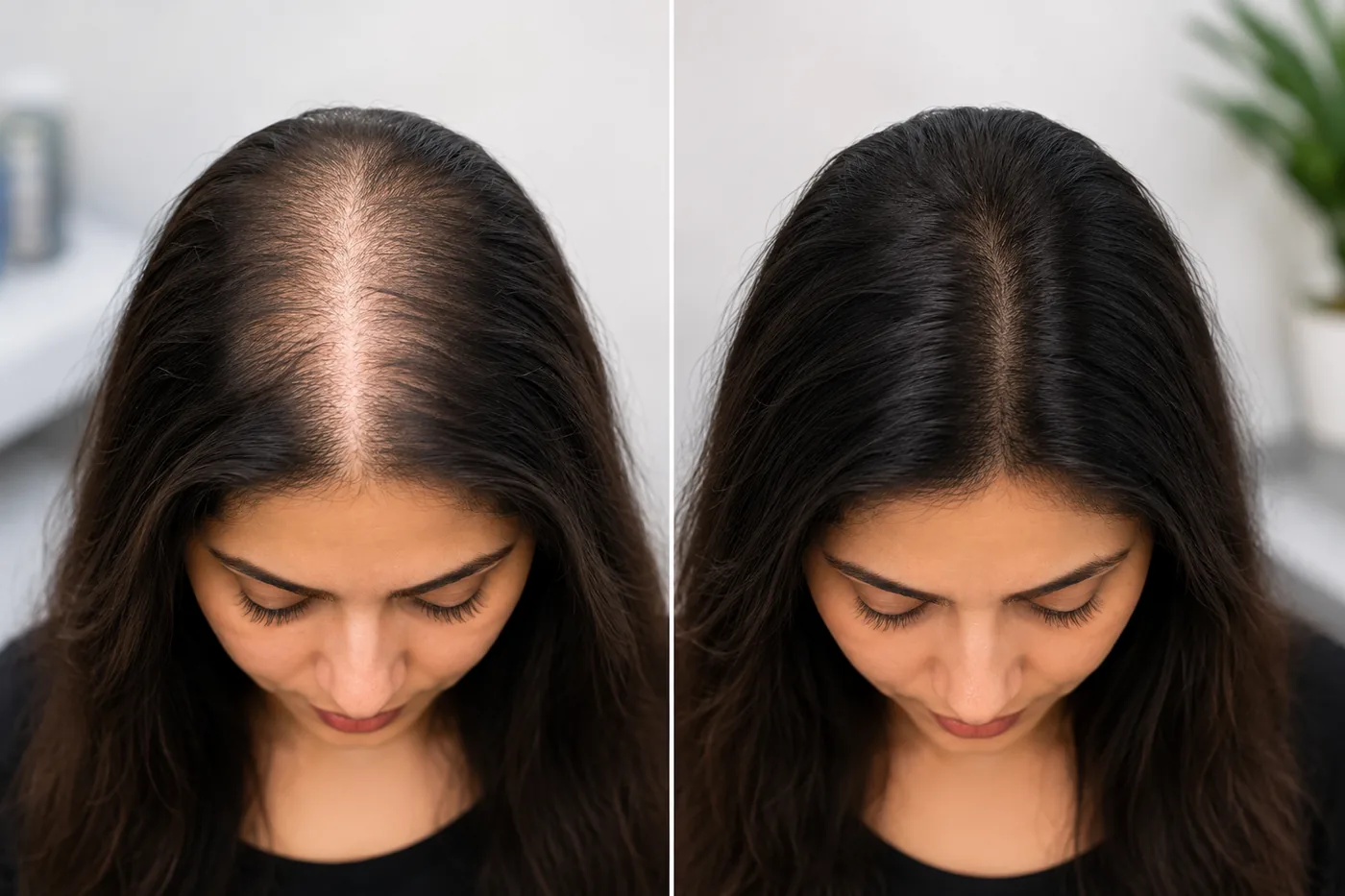
What surgical options exist for female hair loss?
Surgery for women's hair falls into a few distinct categories, each designed for a different problem:
- FUT hair transplant - a strip of scalp is removed from the back of the head and divided into grafts
- FUE hair transplant - individual follicles are extracted one at a time, often with little or no visible shaving
- Surgical hairline lowering - forehead skin is removed and the hair-bearing scalp is moved forward
- Scar and repair surgery - grafts or excision to disguise scars from injury, cosmetic surgery or previous transplants
Eyebrow transplantation is a related procedure using the same graft techniques; see our eyebrow transplant cost guide if that's your concern. Which option suits you depends on the cause of your hair loss, your donor supply, your scalp flexibility and the result you want.
How do FUT and FUE differ for women?
Both move follicles from the back and sides of the scalp to thinning areas, and the transplanted hair grows the same way. The differences are in how the grafts are harvested.
FUT leaves a fine linear scar across the back of the head, but it needs no visible shaving and is often the more cost-effective choice at around $3–$6 per graft. It can also yield a high number of good-quality grafts from a donor area that isn't especially dense - a common situation in women. FUE leaves tiny dot scars instead of a line, which suits women who wear their hair very short at the back, and costs around $5–$8 per graft. Unshaven FUE is slower and usually priced higher. The FUE for women guide goes deeper into this choice.
What is hairline lowering surgery?
Hairline lowering, also called forehead reduction, is designed for women with a naturally high forehead and good hair density behind the hairline. The surgeon removes a band of forehead skin, loosens the scalp and advances it forward, then closes the incision with a carefully designed, irregular edge so hair can grow through the scar over time.
The appeal is an immediate result in a single operation without using donor grafts. The limits are that it depends on how flexible your scalp is, it leaves a scar at the front, and it doesn't help if the hair behind the hairline is thinning. Some women have a small graft session afterward to soften the line.
Can surgery repair scars or previous procedures?
Yes, and repair is a significant part of female hair surgery. Common cases include scars around the hairline or behind the ears after a facelift or brow lift, thinning at the temples after cosmetic surgery, scars from injury or burns, and results from earlier transplants that look unnatural. Scar tissue often has a weaker blood supply than normal skin, so graft survival can be lower, and some surgeons recommend a small test session first. Our hair transplant scars guide explains more.
How do the surgical options compare?
| Procedure | Best for | Anaesthesia | Typical downtime | Typical US cost |
|---|---|---|---|---|
| FUT transplant | Women with longer hair needing a good number of grafts | Local, optional oral sedation | About 7–10 days; sutures or staples removed around 10–14 days | $4,000–$12,000, usually the lower per-graft price |
| FUE transplant | Short hair at the back; avoiding a linear scar | Local, optional oral sedation | About 5–10 days | $4,000–$15,000, higher for unshaven techniques |
| Hairline lowering | Naturally high forehead with dense hair behind it | Local with sedation, sometimes general | About 7–14 days | Often roughly $8,000–$15,000; varies widely |
| Scar repair grafting | Stable scars from surgery, injury or burns | Local | About 5–7 days | Often small-procedure pricing; clinic minimums apply |
Figures are general US ranges, and big metros often sit toward the upper end. Insurance rarely covers any of these procedures unless they're reconstructive, and many clinics offer financing over 24–48 months.
Who should not have hair restoration surgery?
A good surgeon will turn down some women, and it's in your interest. Surgery is usually not recommended if you have:
- Diffuse thinning that also affects the donor area
- Undiagnosed hair loss or ongoing heavy shedding
- Active alopecia areata, lichen planopilaris or frontal fibrosing alopecia
- Untreated medical issues such as significant iron deficiency or thyroid disease
- Pregnancy or breastfeeding
- Bleeding disorders or health problems that make elective surgery unsafe
- Expectations the donor supply can't realistically meet
How do you prepare for surgery?
- Complete your medical workup, including any blood tests the surgeon requests.
- Review medications and supplements with your doctor; some, like blood thinners, fish oil and certain vitamins, may need pausing if your doctor agrees.
- Stop smoking and avoid alcohol in the lead-up, as both can affect healing.
- Hold off on colouring or chemical treatments close to surgery unless your surgeon says otherwise.
- Plan time off - about a week for most desk jobs - and arrange a lift home if you're sedated.
- Start or continue medical treatment if recommended, to protect surrounding hair.
What questions should you ask the surgeon?
- Which procedure do you recommend for me, and why not the alternatives?
- How many women have you treated with this procedure, and can I see their results?
- Are you board-certified, and are you an ISHRS member?
- How much of the procedure will you perform personally?
- What density can I expect, and could I need a second procedure?
- What is the risk of shock loss in my case?
- What does the fee include, and what follow-up care do you provide?
What's the next step?
Book consultations with two or three surgeons who regularly treat women, and ask each to explain which surgery fits your situation. Comparing their reasoning is as valuable as comparing prices. When you're ready, request free quotes from vetted US providers, or read our guide to choosing a provider.
Related guides
Frequently asked
For suitable candidates treated by qualified surgeons, serious complications are uncommon. Typical side effects include swelling, temporary numbness and short-term shedding. Safety depends heavily on proper screening and surgeon experience.
Neither is better overall. Forehead reduction gives an immediate result for a naturally high hairline with dense hair behind it. A transplant suits thinning, recession or a tight scalp. Some women benefit from both.
Hair transplants use local anaesthetic, sometimes with mild oral sedation. Hairline lowering is also often done under local anaesthetic with sedation, though some surgeons use general anaesthesia. Ask what your surgeon uses and why.
Yes, if the donor area can supply more grafts. Many surgeons wait at least 12 months after the first procedure so they can judge the result and the condition of surrounding hair before planning another.
Hair transplants are typically performed by dermatologic surgeons, plastic surgeons or dedicated hair restoration physicians. Look for board certification, ISHRS membership and a strong portfolio of female results.
Yes, all surgery leaves some scarring. FUT leaves a fine line at the back, FUE leaves tiny dots, and hairline lowering leaves a scar at the front. In most women these are hidden well by surrounding hair.
About this guide
This is an independent overview to help you decide. Figures are typical US ranges, not a quote, and general information is not medical advice - confirm details at a consultation. See our methodology and disclosure.