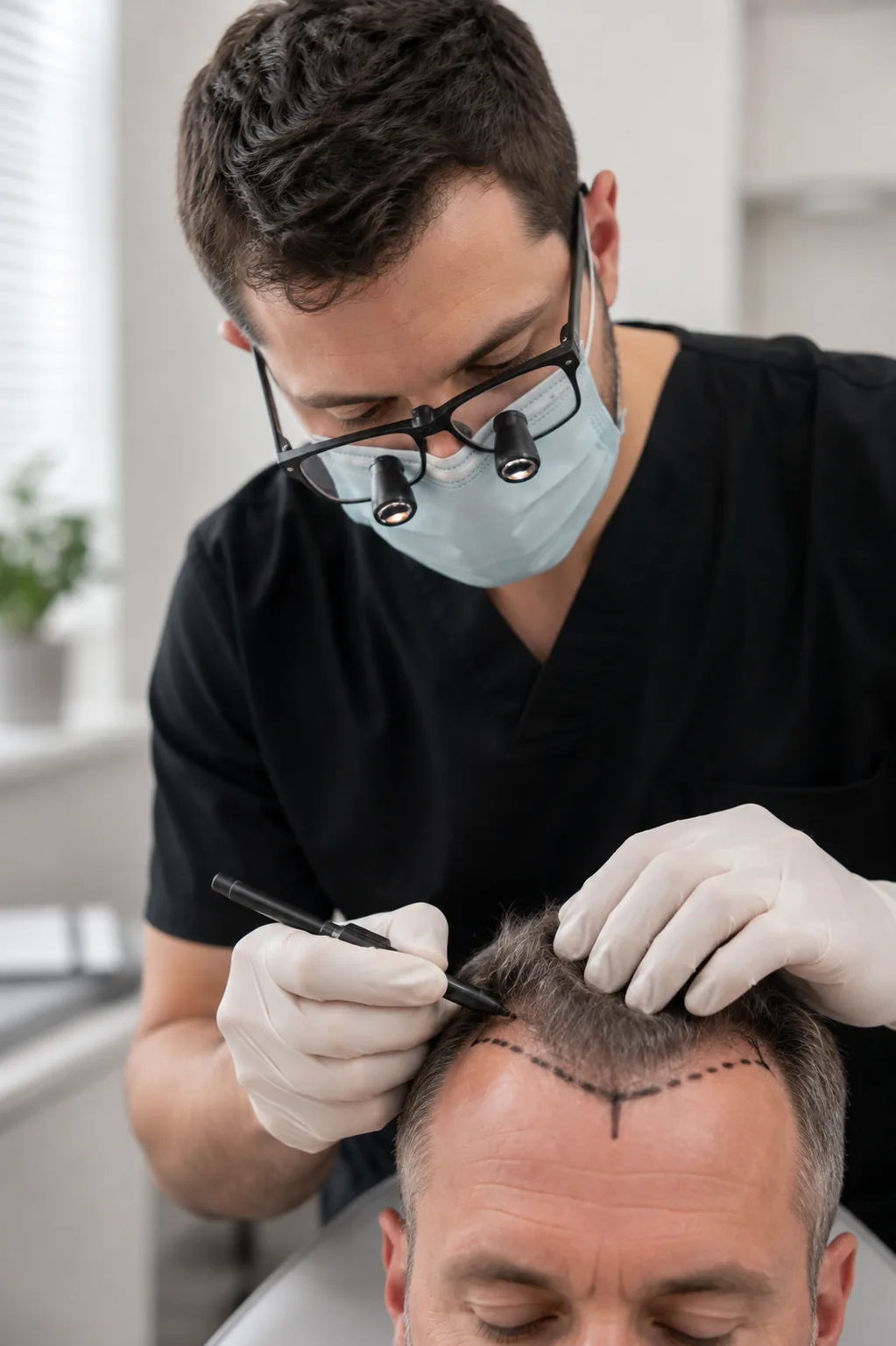
Do all hair transplants leave scars?
Yes. Any procedure that cuts the skin leaves a scar, and a hair transplant involves many small cuts. The goal isn't a scar-free result but scars that are small, flat and hidden in your hair. Marketing phrases like "scarless FUE" are misleading - FUE scars are simply smaller and more spread out.
Hair transplant scars appear in two places. The donor area at the back and sides of the head carries the main scarring. The recipient area, where grafts are placed, heals with tiny marks that are almost never visible once hair grows.
What do FUE and FUT scars look like?
| Feature | FUT (strip) scar | FUE scars |
|---|---|---|
| Shape | A single line, often ear to ear across the back of the head | Hundreds or thousands of small round dots |
| Typical size | Often a thin line of about 1–2 mm when healed well; can widen | Each dot roughly the size of the punch, often under 1 mm |
| Colour | Pale or white line, lighter than surrounding skin | Small white or pale spots |
| Hidden by hair of | Usually a grade 3–4 clipper length or longer, depending on the scar | Usually a grade 1–2 clipper length or longer |
| Main risk | Stretching or widening, especially with tight closure or early strain | A moth-eaten or thinned look if too many grafts are taken from one zone |
Clipper lengths are a rough guide - your scar's width, your hair colour and your skin tone all affect visibility. Our FUE vs FUT guide covers the other differences between the methods.
Why do some transplant scars become noticeable?
Most visible scars trace back to a few causes, some related to surgical technique and some to individual healing:
- Too wide a strip removed in FUT, leaving the closure under tension so the scar stretches
- Poor closure technique - some surgeons use a trichophytic closure, which lets hair grow through the scar edge and helps disguise it
- Over-harvesting in FUE, where extractions are clustered or too dense, so the donor area looks thin or patchy
- Large punches that leave more noticeable dots
- Multiple previous surgeries building up scar tissue
- Keloid or hypertrophic scarring tendencies, which are more common in some people and can run in families
- Early strain on an FUT wound from heavy lifting or neck flexion during healing
- Very short haircuts and high contrast between dark hair and pale skin
How long do hair transplant scars take to heal?
FUE dots usually crust over and heal on the surface within 7–10 days, then fade from pink to pale over a few months. An FUT incision is typically closed with stitches or staples removed around days 10–14. The line is usually pink and firm at first and gradually flattens and lightens over 6–12 months. A scar's final appearance can't really be judged until about a year after surgery, so avoid deciding on revision work too early.
Temporary changes during healing are normal: tightness, mild itching, a slightly raised feel along an FUT line, and patches of numbness that usually improve over weeks to months. Scars that become thick, raised beyond the wound edges, or itchy and growing should be shown to your surgeon.
How can you minimise scarring before and after surgery?
- Tell your surgeon about any history of keloids, raised scars or poor healing, so they can adjust the plan or advise against surgery.
- Ask about donor management - how wide the strip will be, or how FUE extractions will be spread across the donor area.
- Don't smoke in the weeks around surgery, as it slows wound healing.
- Protect an FUT wound by avoiding heavy lifting, strenuous exercise and extreme neck bending for the period your surgeon advises, often several weeks.
- Keep the area clean and follow washing instructions to reduce infection risk.
- Protect scars from sun while they're still pink, since UV exposure can darken or redden them.
Detailed healing guidance is in our aftercare guide.
What treatments can improve visible transplant scars?
Scar repair is common and often very effective at making scars much less noticeable, though a scar can rarely be removed completely.
- FUE into the scar - grafts are placed directly into a linear scar or thin patches to break up the line with hair. Scar tissue has poorer blood supply, so growth may be lower than in normal skin and a test session is sometimes used.
- Scar revision surgery - a widened FUT scar can be cut out and re-closed with better technique, sometimes with a trichophytic closure. This only works if the scalp has enough laxity.
- Scalp micropigmentation (SMP) - cosmetic tattooing that mimics the look of short hair follicles to camouflage both linear and dot scars. It's non-surgical but needs periodic touch-ups as pigment fades.
- Steroid injections or silicone treatments - used by doctors for raised, hypertrophic or keloid scars.
- Growing hair longer - the simplest, cheapest option for many people.
Can scars from old plug transplants be fixed?
Often, yes. Older procedures from decades ago sometimes left obvious plugs in the hairline and multiple scars in the donor area. Repair can involve removing and re-implanting plugs as smaller grafts, adding single-hair grafts in front to soften the look, and camouflaging donor scars with FUE or SMP. The main limit is how much healthy donor hair remains. See common problems and failed transplant repair.
What should you do about a scar that worries you?
If your transplant was less than a year ago, give it time and ask your original surgeon for a review. If you're considering surgery and want to minimise scarring, ask each clinic to show donor-area photos at 12 months, not just the hairline. Either way, a specialist consultation will tell you what's realistic. Request a free quote to compare vetted US providers, including surgeons who handle scar repair.
Related guides
Frequently asked
After FUE, many people can use a very short clipper length, though shaving to the skin may reveal white dots. After FUT, the linear scar is more likely to show with very short hair.
Yes, FUE leaves many tiny round scars, one for each graft removed. They're usually pale dots under 1 mm and are well hidden with a short haircut, but they're not invisible when shaved.
Hair doesn't naturally regrow inside scar tissue, but grafts can be transplanted into a scar. Growth is often somewhat lower than in normal skin because scar tissue has less blood supply.
It varies widely by method and scar size. FUE into a scar is often priced per graft, similar to regular FUE at roughly $5–$8 per graft in the US. SMP and revision surgery are quoted individually.
It can be very effective, especially for dot scars and narrow linear scars in people who keep their hair short. Choose an experienced practitioner, since poorly matched pigment can look unnatural.
Usually, yes. Scars tend to fade, flatten and blend in over 6–12 months. A scar that widens, becomes raised, or stays red beyond that should be checked by a doctor.
Rarely. The small incisions where grafts are placed heal quickly and are hidden by growing hair. Visible marks in the recipient area are more common with old plug techniques.
About this guide
This is an independent overview to help you decide. Figures are typical US ranges, not a quote, and general information is not medical advice - confirm details at a consultation. See our methodology and disclosure.
