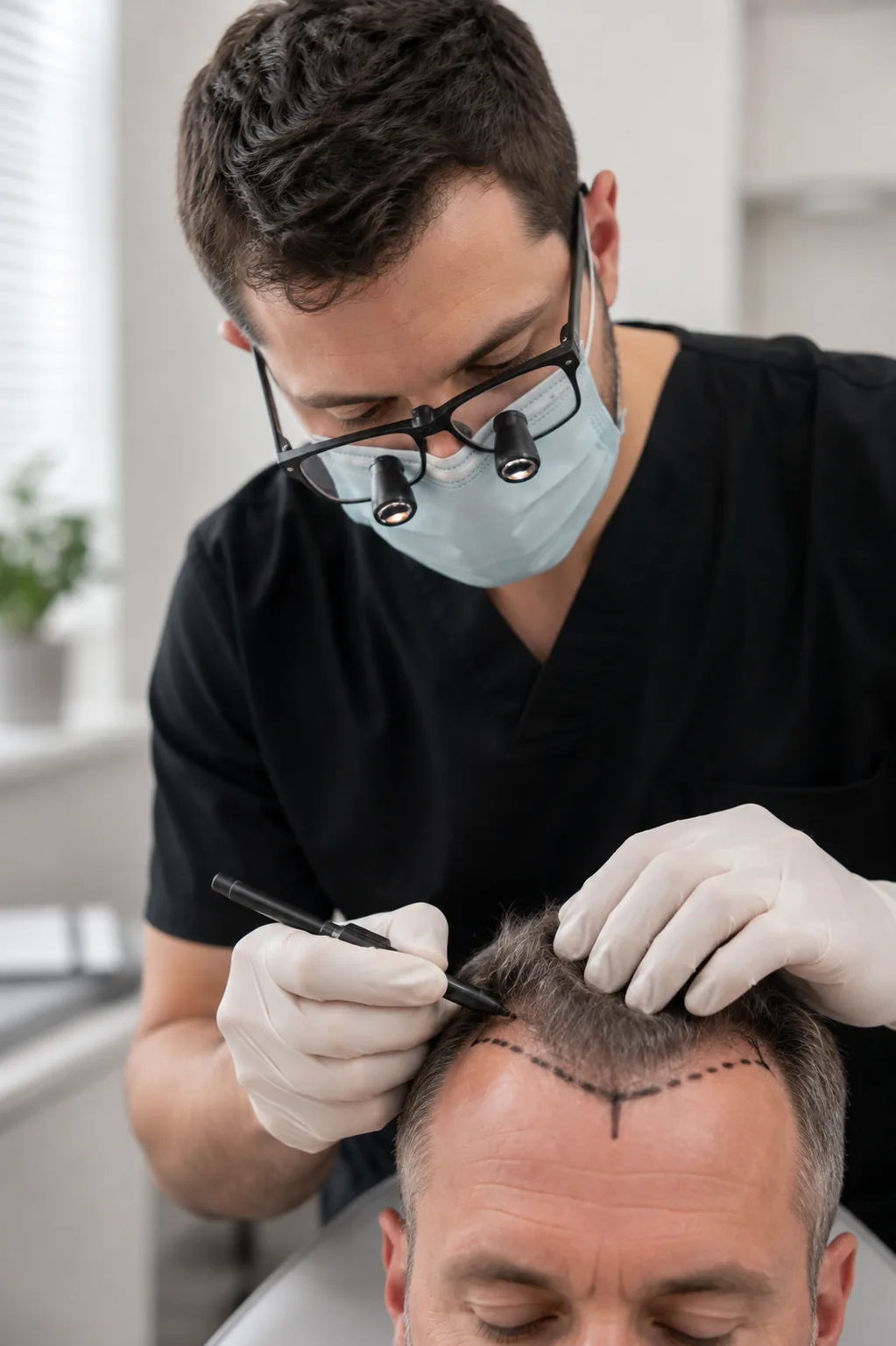
Why is there no single "best" FUE clinic?
Online rankings of the best FUE hair transplant clinics in the USA are usually advertising, not independent testing. No regulator or medical body scores transplant clinics against each other, and results depend heavily on the individual patient: hair calibre, curl, donor density, skin contrast and how far loss will progress.
A surgeon who produces superb results for a Norwood 3 with thick wavy hair may not be the right fit for someone with fine hair and an advanced crown. "Best" really means best for your case. That's why the most useful thing you can do is learn how to judge quality yourself.
What separates a top FUE surgeon from an average one?
FUE is technically demanding. Every graft is removed one at a time, and small errors repeated 2,000 times add up. The differences that matter most are:
- Low transection rates: skilled extraction avoids cutting through follicles, so more grafts survive
- Careful donor management: grafts spread evenly across the safe zone, so the back of the head doesn't look moth-eaten
- Natural hairline design: irregular, age-appropriate, with single-hair grafts at the front
- Correct angle and direction: recipient sites that match how native hair grows
- Graft handling: keeping grafts cool, hydrated and out of the body for as short a time as practical
- Honest planning: telling you what isn't achievable, and preserving donor supply for later
Which credentials should a US FUE surgeon have?
Hair transplantation isn't its own board-certified specialty in the US, so you need to read credentials carefully. Useful signals include:
| Credential or signal | What it tells you | How to check |
|---|---|---|
| Board certification | Completed training and exams in a medical specialty, often dermatology or plastic surgery | Search the certifying board's online directory |
| State medical licence | Legally allowed to practise; shows any disciplinary history | Your state medical board's licence lookup |
| ISHRS membership | Engagement with the International Society of Hair Restoration Surgery and its education | ISHRS member search |
| Years focused on hair restoration | Volume and depth of experience with FUE specifically | Ask directly; look at the case archive's date range |
| Consistent result gallery | Repeatable outcomes, not a few cherry-picked cases | Ask for 12-month photos of patients similar to you |
Membership of a professional society is a helpful signal, not a guarantee. No credential replaces reviewing actual results.
Who actually performs the FUE at the clinic?
This is one of the most important questions and one patients rarely ask. At some clinics the surgeon plans the case and makes recipient sites while trained technicians assist. At others, technicians carry out large parts of the procedure with little physician involvement. Ask exactly who will:
- Assess your donor area and set the graft plan
- Draw the hairline
- Perform the extractions
- Create the recipient sites (angle, direction and density)
- Place the grafts
Rules on what non-physicians may do vary by state. A clinic that is vague about this, or won't tell you who is in the room, is a red flag. More on this in what to expect from an FUE clinic.
How much does a top-quality FUE cost in the US?
Pricing varies by region, surgeon demand and how the clinic charges. As a guide, US FUE typically runs about $5–$8 per graft.
| Session size | Typical grafts | Approximate US FUE cost |
|---|---|---|
| Small | 500–1,500 | $4,000–$8,000 |
| Medium | 1,500–2,500 | $8,000–$12,000 |
| Large | 2,500–4,000+ | $12,000–$15,000+ |
Big metros such as New York, Los Angeles and Miami often sit toward the upper end of the range, and very high-demand surgeons can charge more. A higher price doesn't guarantee a better result, but an unusually low US quote deserves extra scrutiny.
When comparing quotes, check whether the price is per graft or a flat fee, whether it assumes shaving, and whether the clinic charges for grafts extracted or grafts successfully placed. Ask too whether follow-up visits, post-op medication and any PRP add-on are included, since these can add several hundred dollars. Financing over 24–48 months is common at US clinics, and insurance almost never pays for cosmetic hair restoration. See FUE prices for a full breakdown.
How should you compare FUE clinics across different states?
Many patients travel within the US for a specific surgeon. If you're considering it, compare on the same basis:
- Price per graft and the total for the same graft count
- Whether consultation, medication, PRP and follow-ups are included
- Travel, hotel and time off - most people fly home 1–3 days after surgery
- How follow-up works remotely, including photo check-ins at 3, 6 and 12 months
- What the clinic does if growth is poor
You can browse state-by-state information through our locations hub.
What are the red flags when choosing an FUE provider?
- Guaranteed graft survival, density or a "100% success rate"
- Pressure to book on the day, or discounts that expire within hours
- Very high graft counts proposed without examining your donor area
- Before-and-after photos with different lighting, wet hair or no dates
- No named physician, or a surgeon you only meet on surgery day
- Encouraging young patients to lower the hairline aggressively
Our choosing a provider guide goes deeper on vetting.
Is the best US FUE worth it compared with going abroad?
Turkey all-inclusive packages often cost around $1,500–$3,500, far below US pricing. Some overseas surgeons are excellent, but quality varies widely, physician involvement is sometimes limited, and follow-up care or repairs are harder from a distance. US surgery costs more but usually comes with local accountability, easier follow-up and clearer oversight. Compare both honestly with Turkey vs USA costs.
How do you find the right FUE surgeon for you?
Shortlist two or three board-certified surgeons, send the same photos to each, and compare their graft estimates, hairline plans and long-term advice side by side. Request a free quote and we'll connect you with vetted US FUE providers so you can compare real proposals.
Related guides
Frequently asked
There's no objective ranking. The best surgeon for you is board-certified, experienced in FUE, personally involved in your procedure, and can show consistent 12-month results on patients with hair like yours.
No city is inherently better. Large metros have more surgeons to choose from but often higher prices. Many patients get excellent results in smaller cities or travel to a specific surgeon.
Not necessarily. Robotic systems can help with consistent extraction, while skilled manual or motorised FUE gives the surgeon more fine control. The surgeon's experience matters more than the device.
Many US clinics do roughly 1,500–3,000 grafts in a single day, depending on donor supply and team size. Larger cases are sometimes split over two consecutive days.
Low price alone isn't proof of poor care, but very cheap US quotes can mean limited physician involvement or high-volume technician-led work. Ask exactly who does each step before booking.
Search the certifying board's online directory and your state medical board's licence lookup. Both are free and show whether the doctor is certified and has any disciplinary actions.
Many do, often through medical credit providers with terms of 24–48 months. Compare interest rates carefully. Read more in our financing guide.
About this guide
This is an independent overview to help you decide. Figures are typical US ranges, not a quote, and general information is not medical advice - confirm details at a consultation. See our methodology and disclosure.
