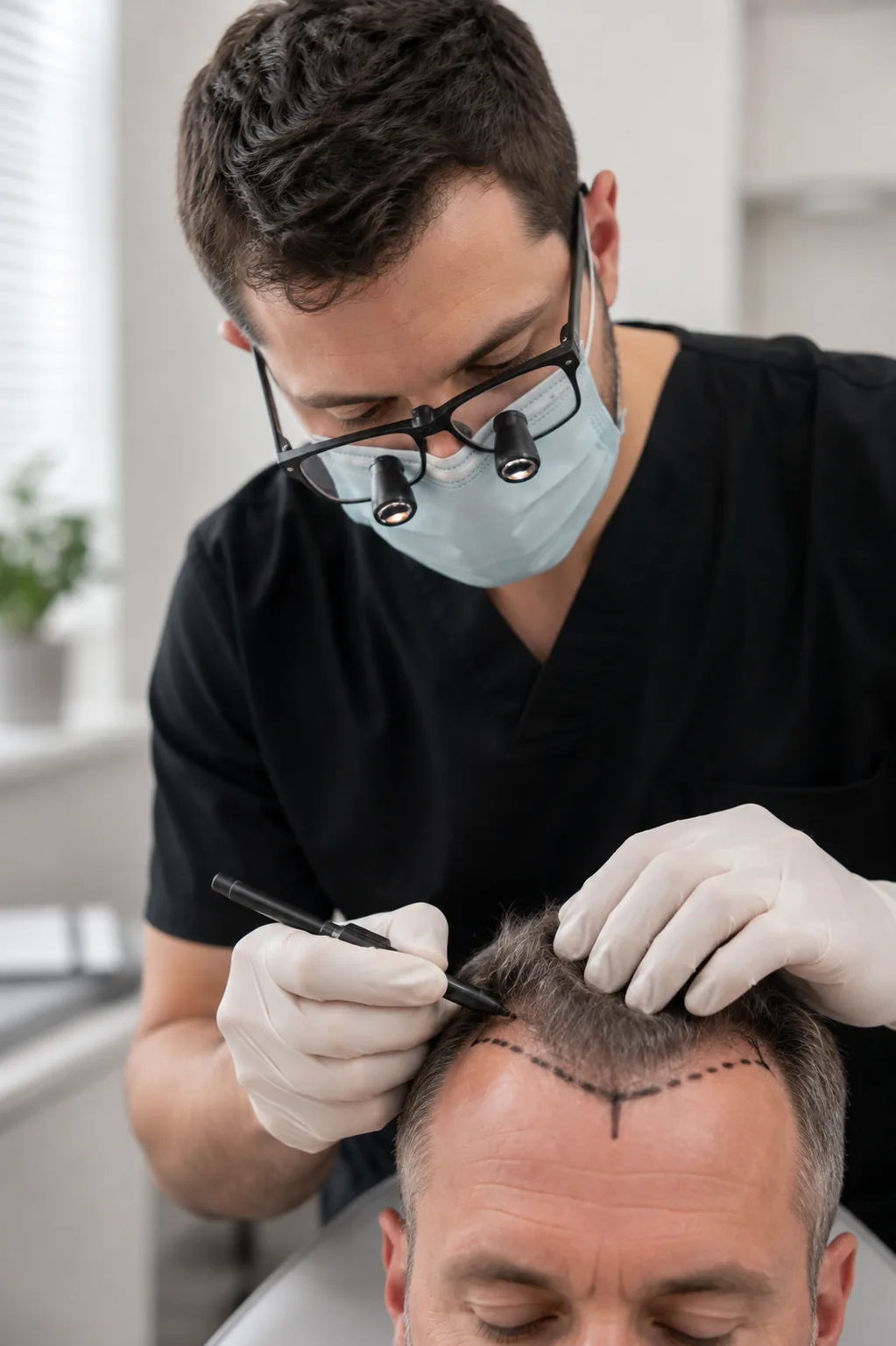
Why compare FUT with FUE again?
Over the past decade, FUE has dominated hair transplant advertising, and many clinics now offer only FUE. That has left a lot of patients assuming FUT is outdated. In reality, many experienced hair surgeons still perform FUT regularly, because for certain scalps, hairstyles and graft needs it has real advantages.
This page looks at the comparison from FUT's side: when a strip procedure makes sense, what modern FUT involves, and how to weigh its scar against its benefits. For a balanced overview of both, see FUE vs FUT.
How does a modern FUT procedure work?
- Donor planning: the surgeon marks a narrow strip in the most stable part of the donor area, sized to the number of grafts needed and your scalp laxity.
- Strip removal: under local anaesthetic, the strip is removed at a shallow depth to avoid nerves and larger blood vessels.
- Closure: the wound is closed with stitches or staples. Many surgeons use a trichophytic closure, trimming one edge so hair grows through the scar and camouflages it.
- Microscopic dissection: technicians divide the strip into individual follicular units under stereo microscopes.
- Placement: recipient sites are created and grafts placed exactly as in FUE.
Stitches or staples usually come out at around 10–14 days. The whole procedure typically takes 4–8 hours, similar to FUE, and is done as a same-day outpatient surgery. Harvesting the strip itself is quick; most of the day is spent on dissection and graft placement, which is why a skilled technician team matters as much in FUT as the surgeon's closure.
When is FUT the better choice than FUE?
| Your situation | Often better fit | Why |
|---|---|---|
| Need a very large number of grafts in one session | FUT | A strip can yield many grafts efficiently without spreading extraction across the whole donor area |
| Wear hair at least moderately long | FUT | A well-closed linear scar is usually hidden |
| Budget is a major factor | FUT | Lower cost per graft |
| Planning several procedures over a lifetime | FUT first, FUE later | Preserves the surrounding donor area for future extraction |
| Fine or low-density donor hair | Case by case, often FUT | Dissection under microscopes can protect delicate grafts |
| Like very short or buzzed hairstyles | FUE | No linear scar to reveal |
| Tight scalp with little laxity | FUE | A strip may be hard to close without tension |
| Want the quickest return to exercise | FUE | No incision to protect |
What are the real advantages of FUT?
- Graft quality: microscopic dissection allows technicians to preserve tissue around each follicle, which can reduce transection
- Efficiency: harvesting a strip is faster for the surgeon than thousands of individual extractions
- Lower cost: typically about $3–$6 per graft in the US versus $5–$8 for FUE
- No need to shave the whole donor area: surrounding hair falls over the stitched area immediately
- Donor preservation: the rest of the donor area remains untouched and available for later FUE
- Uses the safest donor zone: the strip comes from the central, most stable band of hair
What are the downsides of FUT?
- Linear scar: usually thin, but visible with very short cuts, and some scars stretch or widen
- More donor discomfort: tightness and soreness for 1–2 weeks
- Stitches or staples: need removal and careful care until healed
- Activity limits: surgeons often advise avoiding heavy lifting and neck-straining exercise for a few weeks
- Temporary numbness above or along the scar, usually resolving over months
- Fewer surgeons offer it, so choice may be narrower in some areas
Can an FUT scar be improved or hidden?
Yes, if it becomes a concern. Options include FUE grafts placed directly into the scar, scalp micropigmentation to camouflage it, and in some cases surgical scar revision. Keeping hair at a moderate length is the simplest solution. How your scar heals depends on skin type, scalp tension, closure technique and following aftercare - including avoiding strain on the wound in the first few weeks. See hair transplant scars for more.
How much can FUT save compared with FUE?
Savings depend on the clinic, but the per-graft difference adds up with larger sessions. If a surgeon charges $1–$3 less per graft for FUT than for FUE, a 2,000-graft session works out roughly $2,000–$6,000 cheaper. Many clinics use tiered or flat pricing, though, so real gaps can be smaller or larger than straight per-graft maths suggests. Overall US transplants commonly fall between $4,000 and $15,000.
Remember to compare the total, not just the headline rate. Ask whether each quote covers the same number of grafts, whether it's based on grafts extracted or placed, and whether consultation, medication, stitch removal and follow-ups are included. Also factor in time off: FUT patients may need a few extra days before returning to physical work. More in cost per graft.
What should you ask a surgeon about FUT?
- Do you perform both FUT and FUE, and which would you recommend for me?
- How wide do you expect my scar to be, and what closure technique do you use?
- How many grafts can my scalp laxity support in one strip?
- Can I see healed donor scar photos at different hair lengths?
- How would you handle future sessions after FUT?
- What are the activity restrictions while the incision heals?
A good FUT surgeon should be comfortable showing you healed scars on real patients, discussing your scalp laxity honestly, and explaining when they'd send you for FUE instead. If a clinic only offers one technique, ask what they'd recommend for someone who wasn't a good fit for it.
How do you get an honest FUT vs FUE recommendation?
The most reliable advice comes from surgeons who offer both techniques and have no reason to push one. Request a free quote to compare opinions from vetted US hair surgeons experienced in FUT and FUE. You can also explore all options in our types and options hub.
Related guides
Frequently asked
No. FUE is more heavily marketed, but FUT remains a well-established technique that many experienced surgeons still use, especially for large sessions and patients with longer hair.
Length depends on the number of grafts needed, often running across the back of the head. Width is usually thin with a good closure, but varies with skin, scalp tension and healing.
Moderate short cuts usually hide the scar well. Very close clipper cuts or shaved styles may reveal it. Ask your surgeon to show healed scar photos at various lengths.
Typically around 10–14 days after surgery. Some surgeons use dissolvable stitches, which don't need removal but still need gentle care while healing.
It can yield more grafts in a single session for suitable patients. Over a lifetime, total graft numbers depend on donor supply, and many patients use both techniques.
Both are low-risk in qualified hands. FUT has a larger wound, so it carries slightly more donor discomfort, temporary numbness and scar-related concerns than FUE.
About this guide
This is an independent overview to help you decide. Figures are typical US ranges, not a quote, and general information is not medical advice - confirm details at a consultation. See our methodology and disclosure.
