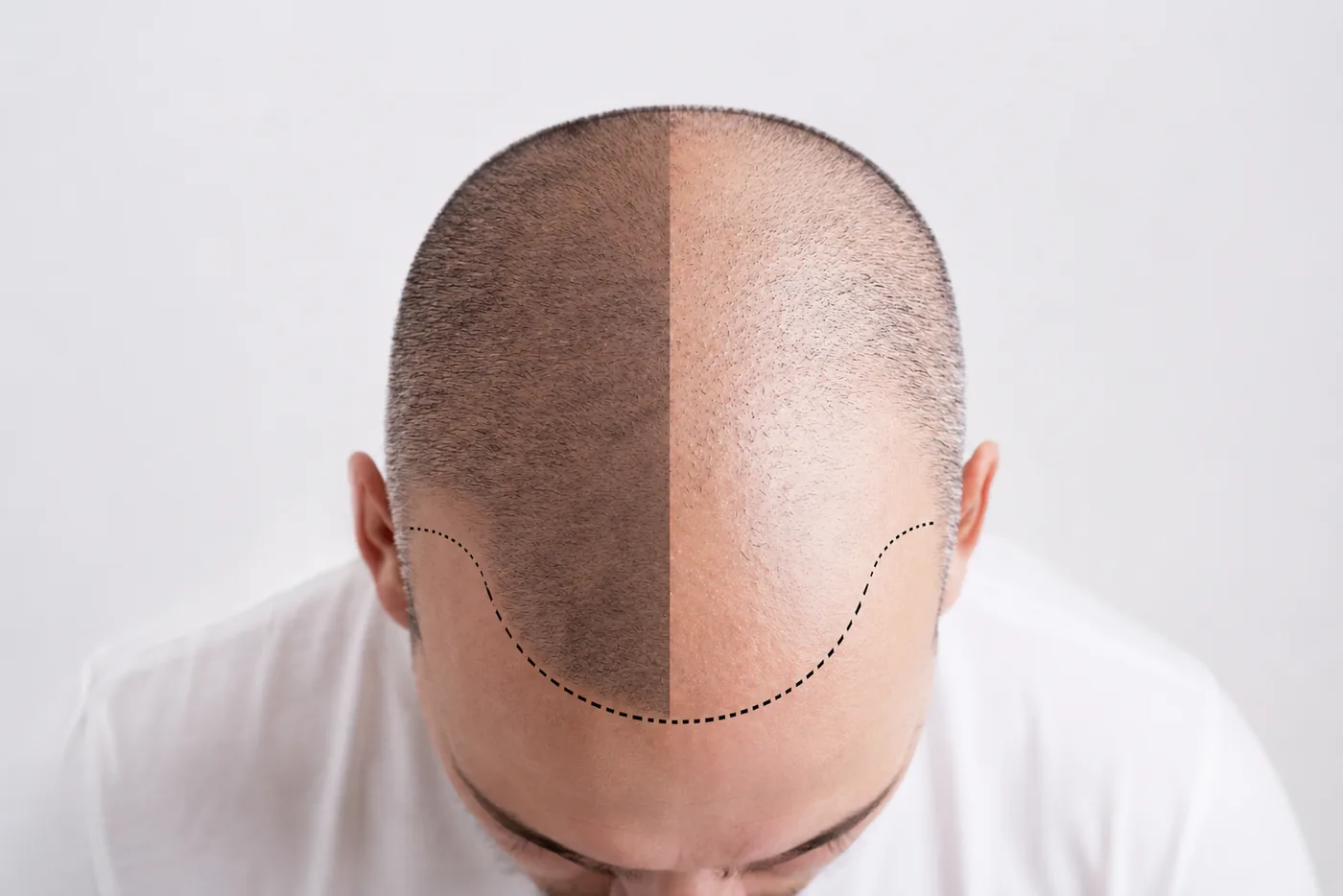
How does Bosley hair restoration work in principle?
Bosley is a long-established national US hair restoration chain, and its surgical restoration relies on the same core medical principle used by hair transplant surgeons worldwide. We're independent and not affiliated, so we can't describe any proprietary methods it may market - ask directly about those. The underlying biology, though, is universal.
A hair transplant doesn't create new hair. It redistributes existing follicles. Healthy follicles are taken from the donor area at the back and sides of the head, then implanted into areas where hair has thinned or disappeared. Because the moved follicles carry their own genetic programming, they carry on growing hair in their new location. For the practical, day-of-surgery view, see our guide to the Bosley hair restoration procedure.
Why does transplanted hair keep growing?
Male pattern hair loss is driven mainly by dihydrotestosterone (DHT), a hormone derived from testosterone. In people with a genetic sensitivity, DHT gradually shrinks follicles on the top and front of the scalp - a process called miniaturisation - until they produce only fine, short hairs or none at all.
Follicles in a horseshoe-shaped zone around the back and sides are usually far less sensitive to DHT. That's why even men with advanced baldness often keep hair there. Surgeons call this donor dominance: a follicle tends to behave according to where it came from, not where it's placed. Move a DHT-resistant follicle to the crown, and it generally stays resistant. That's the reason transplant results are considered long-lasting - see are hair transplants permanent.
What is a follicular unit, and why does it matter?
Hair doesn't grow as single strands spread evenly across the scalp. It grows in natural groupings of one to four hairs, called follicular units. Modern transplants move these units intact, which is why they're counted as "grafts" rather than hairs.
This matters for two reasons. First, it produces a natural look: surgeons place single-hair grafts along the hairline and multi-hair grafts behind it for density, mimicking how hair grows naturally. Second, it's why graft counts don't equal hair counts - 2,000 grafts might contain roughly 4,000–5,000 hairs, depending on the person. Older "plug" transplants, which moved larger clumps, are what gave early hair restoration its unnatural reputation.
How do grafts survive being moved?
Once removed, a graft has no blood supply, so the team's job is to keep it healthy until it's placed. Graft survival depends on careful technique:
- Gentle handling - grafts are held by the surrounding tissue, not the bulb, to avoid crushing
- Hydration and cooling - grafts are kept in a chilled storage solution so they don't dry out
- Short time out of the body - efficient teams minimise the time between extraction and placement
- Correctly sized recipient sites - incisions matched to graft size so grafts sit snugly
- Correct angle and direction - so hair grows the way surrounding hair does
Within days, new blood vessels begin to connect to the graft, and within about a week to ten days grafts are generally considered securely anchored.
Why does transplanted hair fall out before it grows?
Every follicle cycles through a growth phase (anagen), a short transition (catagen) and a resting phase (telogen), after which the hair sheds and a new one starts. The trauma of being moved pushes most transplanted follicles into the resting phase. So around weeks 2–4, most transplanted hairs shed.
This is expected and doesn't mean the grafts have failed. The follicle stays in the skin, rests for a couple of months, then re-enters the growth phase and starts producing new hair. Some people also notice temporary shedding of existing hair near the grafts, sometimes called shock loss, which usually recovers.
What happens month by month as the transplant works?
| Time after surgery | What's happening biologically | What you'll typically see |
|---|---|---|
| Days 1–10 | Grafts anchor and form new blood supply | Small scabs, redness, some swelling |
| Weeks 2–4 | Follicles enter the resting phase | Transplanted hairs shed |
| Months 1–3 | Follicles rest, then restart growth | Area looks much like before surgery |
| Months 3–6 | New anagen hairs emerge, fine at first | Visible growth starting; noticeable change by month 6 |
| Months 6–12 | Hairs thicken and lengthen | Density and texture improve steadily |
| Months 12–18 | Final maturation, slower in the crown | Final result, around 12 months (up to 18 for crown) |
For a care-focused version of this timeline, see the FUE recovery timeline.
What affects how well a hair transplant works?
- Donor quality - density, hair thickness and curl all affect how much coverage each graft gives
- Contrast - low contrast between hair and skin colour tends to look fuller
- Team skill - handling, placement and hairline design
- Stage and stability of loss - very young patients with progressing loss are harder to plan for; see the best age for a hair transplant
- Aftercare - protecting grafts in the first two weeks
- Health factors - smoking and some medical conditions can impair healing
Does a transplant stop future hair loss?
No. It replaces hair in treated areas but does nothing for the DHT-sensitive native hair around it, which can keep thinning. That's why many surgeons recommend continuing medical therapy such as minoxidil or finasteride alongside surgery. Both must be continued to keep their benefit, and finasteride is a prescription drug with possible side effects to discuss with a doctor.
Transplanted follicles also can't be replaced once the donor area is used up, so protecting the hair you already have makes the most of a limited supply over your lifetime.
How do you find out if it would work for you?
A consultation with a qualified physician can assess your donor supply, loss pattern and goals. Compare opinions from more than one provider, and read our process hub for what to expect. When you're ready, request a free quote to compare vetted US providers.
Related guides
Frequently asked
Surgical hair transplants use your own hair follicles, moved from the donor area to thinning areas. We're not affiliated with Bosley, so ask directly about any non-surgical or cosmetic hair products it may also offer.
No. Hair from another person would be rejected by your immune system without powerful anti-rejection drugs, which aren't used for cosmetic procedures. Transplants use only your own follicles.
With skilled handling, most grafts are expected to survive, but survival varies with technique, team experience and individual healing. Be wary of any clinic guaranteeing a specific survival rate.
It can help if there's enough donor hair at the back and sides. With extensive baldness, the donor supply may not cover the whole scalp, so surgeons often prioritise the front for the biggest visual impact.
New hairs emerging from months 3–6 are often fine and wispy. They typically thicken and lengthen over the following months, which is why the final result isn't judged until about 12 months.
It can, for women with stable, localised loss and a strong donor area. Many women have diffuse thinning that also affects the donor zone, which makes them poorer candidates. See our female hair transplant guide.
Yes. Transplanted follicles age normally, so they grey at roughly the same rate as the donor hair they came from.
About this guide
This is an independent overview to help you decide. Figures are typical US ranges, not a quote, and general information is not medical advice - confirm details at a consultation. See our methodology and disclosure.