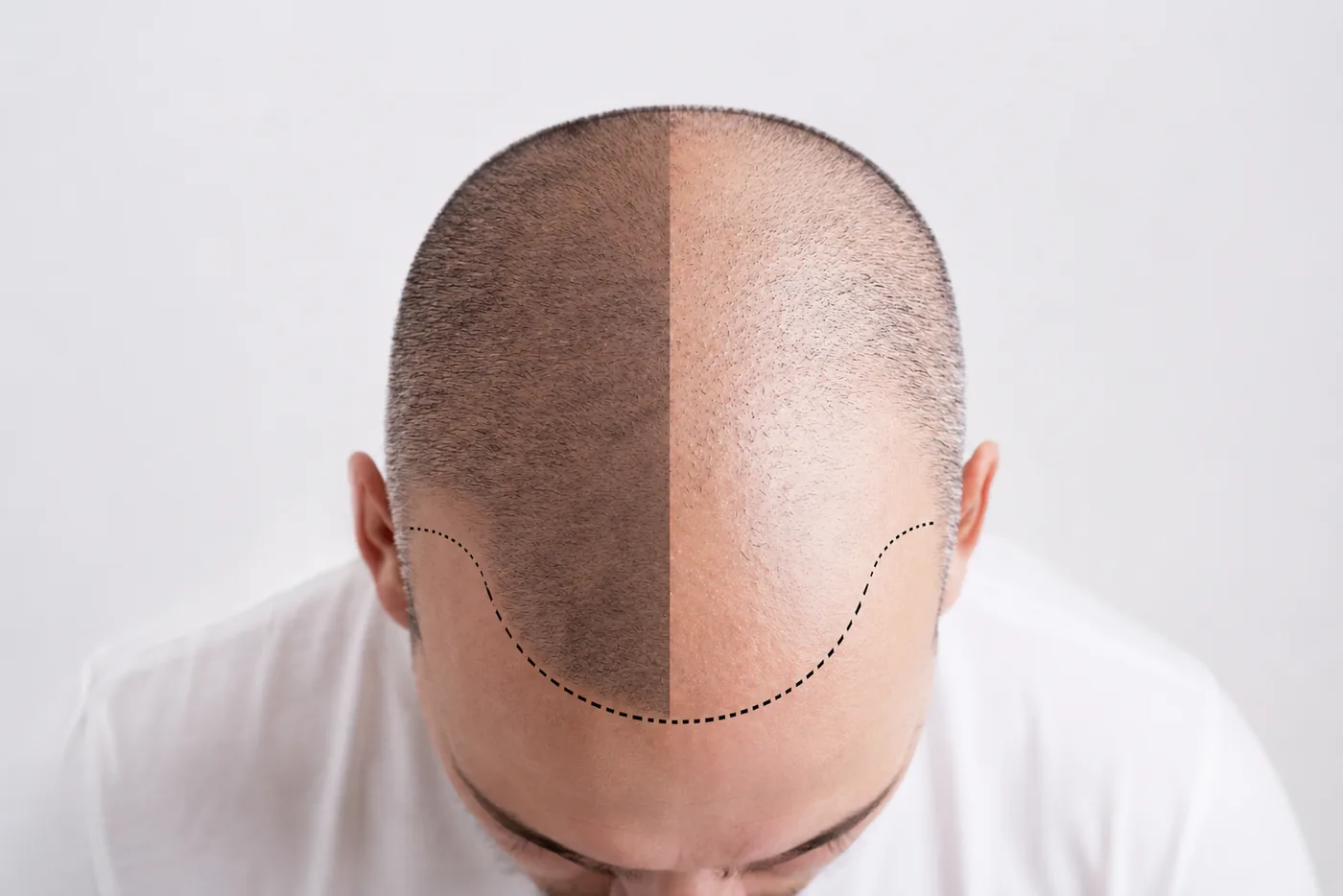
What does a Bosley hair restoration procedure involve?
Bosley is a long-established national US hair restoration chain, and like other large providers it works within the standard medical framework for hair transplants. We're an independent information service with no affiliation, so we can't speak to their internal protocols, current pricing, or staff. What we can do is explain how this type of procedure normally runs, so you know what to expect and what to ask.
In broad terms, any surgical hair restoration moves healthy follicles from the back and sides of the scalp (the donor area) to thinning or bald areas. The procedure is outpatient, done under local anaesthetic, and usually takes 4–8 hours depending on the number of grafts. You go home the same day.
What happens at the consultation before surgery?
The consultation decides whether you should have surgery at all, so treat it as the most important step. A thorough one usually covers:
- Diagnosis - confirming the cause of hair loss. Pattern baldness is the usual reason, but thyroid problems, iron deficiency, and some scalp conditions need ruling out first.
- Donor assessment - hair density and quality at the back of the head, which caps how many grafts you can ever move.
- Graft estimate - a number (or range) of grafts for the areas you want treated. See how many grafts you might need.
- Hairline design - a drawn proposal that should look age-appropriate, not the hairline you had at 18.
- Medical therapy - whether minoxidil or finasteride should be used to protect existing hair.
- A written quote - graft count, technique, price, and what's included.
If you leave without clear answers on these points, don't book yet. Ask who assessed you: a physician or a sales consultant.
Which transplant techniques might be offered?
Most US providers offer one or both of the two mainstream harvesting methods. Check directly which techniques are available at your nearest location, as offerings can differ between offices and change over time.
| Technique | How grafts are taken | Donor scar | Typical US price |
|---|---|---|---|
| FUE (follicular unit extraction) | Individual follicular units removed with a tiny punch | Small scattered dots, easy to hide with short hair | ~$5–$8 per graft |
| FUT (strip method) | A thin strip of scalp removed, then divided under microscopes | One fine linear scar, hidden under longer hair | ~$3–$6 per graft |
Neither is automatically better. FUT can yield many grafts in one session and costs less per graft; FUE suits people who wear their hair short and want a quicker donor recovery. Our FUE vs FUT comparison goes deeper.
What does surgery day look like, step by step?
Timings vary with graft count, but a typical day runs like this:
| Stage | What happens | Approximate time |
|---|---|---|
| Check-in and consent | Paperwork, photos, review of the plan and hairline marking | 30–60 minutes |
| Preparation | Donor area trimmed; optional mild oral sedation | 15–30 minutes |
| Local anaesthetic | Numbing injections to donor and recipient areas | 10–20 minutes |
| Harvesting | Grafts removed by FUE punch or FUT strip | 1.5–3 hours |
| Recipient sites and placement | Tiny incisions made, then grafts placed one by one | 2–4 hours |
| Discharge | Aftercare briefing, medications, follow-up appointment | 20–30 minutes |
You're awake throughout, with breaks for lunch and the bathroom. Arrange for someone to drive you home if you've had sedation.
Who actually performs each part of the procedure?
This is worth asking at any clinic, but especially at a large multi-location provider. In most US practices a licensed physician handles the medical assessment, anaesthetic and key surgical decisions, while trained technicians often help with graft dissection and placement. That team model is normal and can work well.
What you want to know is exactly how the work is divided. Ask who designs the hairline, who makes the recipient incisions (which determine angle and direction, and so how natural the result looks), who extracts the grafts, and how experienced the technician team is. Ask whether the doctor is board-certified and whether they're a member of the ISHRS. Get the answers in writing.
It's also fair to ask whether the physician you meet at consultation will be the one operating on the day, and how many procedures that doctor and team perform each week. A clear, specific answer is a good sign; vague reassurance is not.
How should you prepare in the two weeks before?
Your provider will give specific instructions, and theirs take priority. Common preparation steps include:
- Stop smoking, or at least cut back, as it can slow healing
- Avoid alcohol for several days beforehand
- Ask your doctor about pausing blood-thinning medications and supplements such as aspirin, fish oil or vitamin E - never stop prescribed medication without advice
- Don't cut your hair unless told to; the clinic trims what's needed
- Plan 3–7 days off work, depending on your job and how visible healing will be
- Buy a loose, button-up shirt and a travel pillow for sleeping upright
What happens in the first two weeks after?
Night one is usually the sorest, and swelling on the forehead can appear on days 2–4. Tiny scabs form around each graft and typically fall away within 7–10 days with gentle washing. FUT stitches or staples usually come out around days 10–14.
Around weeks 2–4 most transplanted hairs shed. That's expected - the follicles stay put and start growing new hair from about month 3, with visible change around month 6 and the final result near month 12 (up to 18 for the crown). For the full sequence, see the recovery timeline, or read how this kind of restoration works biologically.
What should you do before booking a procedure?
Get at least two or three consultations, including one with an independent surgeon, and compare graft estimates, technique recommendations and total price side by side. Our guide to choosing a provider lists the questions that matter, and the cost guide explains typical price ranges. When you're ready, request a free quote to compare vetted US providers with no obligation.
Related guides
Frequently asked
We can't confirm any single provider's schedule, but hair transplants in the US generally take 4–8 hours in one day. Smaller sessions of a few hundred grafts can finish sooner; very large sessions may run longer or be split over two days.
No. Routine hair transplants are done under local anaesthetic, so you stay awake. Some clinics offer mild oral sedation to help you relax. Read more in our hair transplant pain guide.
For FUE the donor area is usually trimmed short, and sometimes the recipient area too. FUT generally needs only a narrow strip trimmed. Some clinics offer no-shave or partial-shave options for smaller sessions, often at a higher price.
Many people with desk jobs return within 3–7 days. The main limit is appearance - scabs and redness - rather than pain. Physical jobs may need up to two weeks, and strenuous exercise is usually paused for 10–14 days.
Possibly. Hair loss often continues around transplanted areas, and larger bald areas can need a second session for density. Continuing medical therapy can reduce the chance you'll need another surgery later.
You'll see the new hairline shape immediately, but most transplanted hairs shed within a few weeks. Real growth starts around month 3, with the final result at roughly 12 months.
Large chains use the same core surgical methods - FUE and FUT - as independent clinics. Differences tend to be in team structure, experience, pricing and aftercare. Ask any provider to explain their process and who does each step.
About this guide
This is an independent overview to help you decide. Figures are typical US ranges, not a quote, and general information is not medical advice - confirm details at a consultation. See our methodology and disclosure.